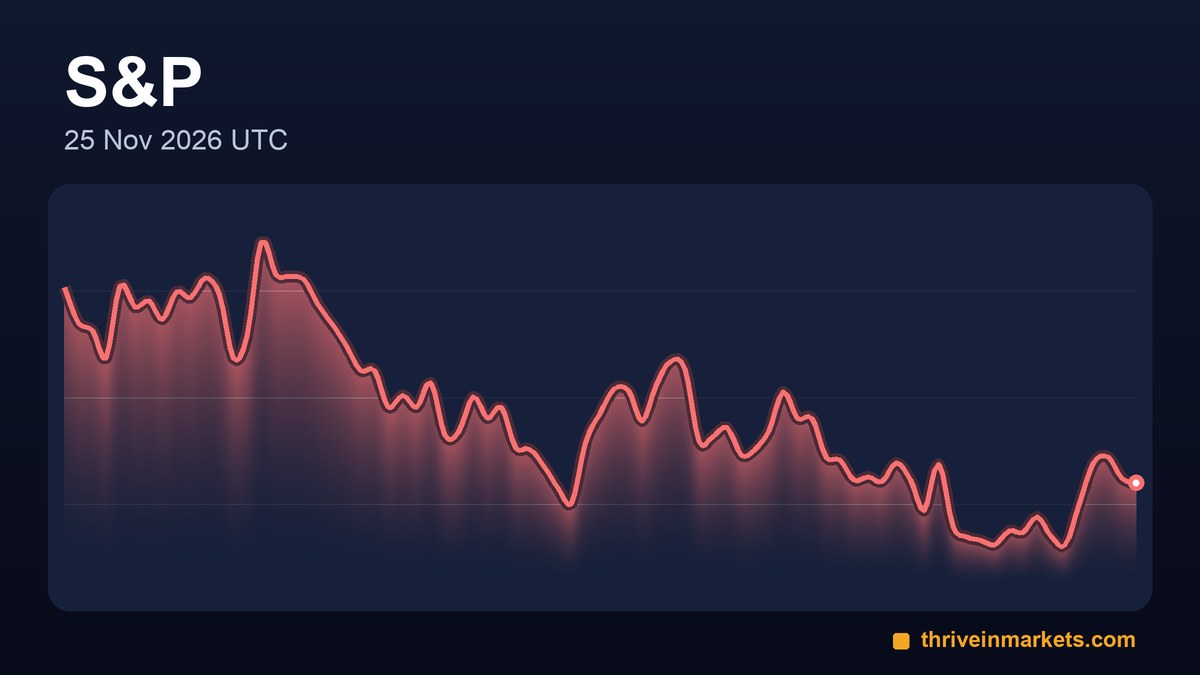
S&P 500 futures fell on Wednesday as an AI-driven selloff hit Asia's chip stocks, with South Korea's Kospi down more than 5% and Japan's Nikkei down about 2.5%. As flagged in yesterday's morning analysis, Monday's relief rally was fragile, and it has now faded in two sessions.
Prices as of 06:30 UTC. US stock levels are overnight futures, and Tuesday's cash closes are labeled as such.
- Investors are asking again whether debt-funded AI spending will pay off, and Asian chipmakers took the hit.
- US tariff findings on 16 trading partners could land as soon as today, which adds to the nerves.
- US inflation data at 13:30 UTC is the last big test before the Fed's December 9 meeting.
US Futures Slip After Tuesday's Tech Slide
S&P 500 futures are near 7,169, down about 0.7% from Tuesday's settlement. Nasdaq 100 futures are down about 1.3%. On Tuesday the S&P 500 closed at 7,201, and the Nasdaq fell about 1.5% while the Dow rose.
The wider picture is weak too: the MSCI Asia-Pacific index excluding Japan fell about 2.3%. Scenarios to watch: a move back above Monday's 7,237 close would show buyers returning, while a slide toward Friday's 6,910 close would erase the rebound.
- Futures point to a second lower open for tech
- Monday's rebound has mostly faded
Story of the Day: Asia's AI Selloff
Taiwan and South Korea took the worst of it. Taiwan's main index fell as much as 8.6%, and TSMC dropped more than 8% at one point. Samsung Electronics and SK Hynix each lost around 9% or more, and Korea briefly paused program trading after Kospi futures dropped.
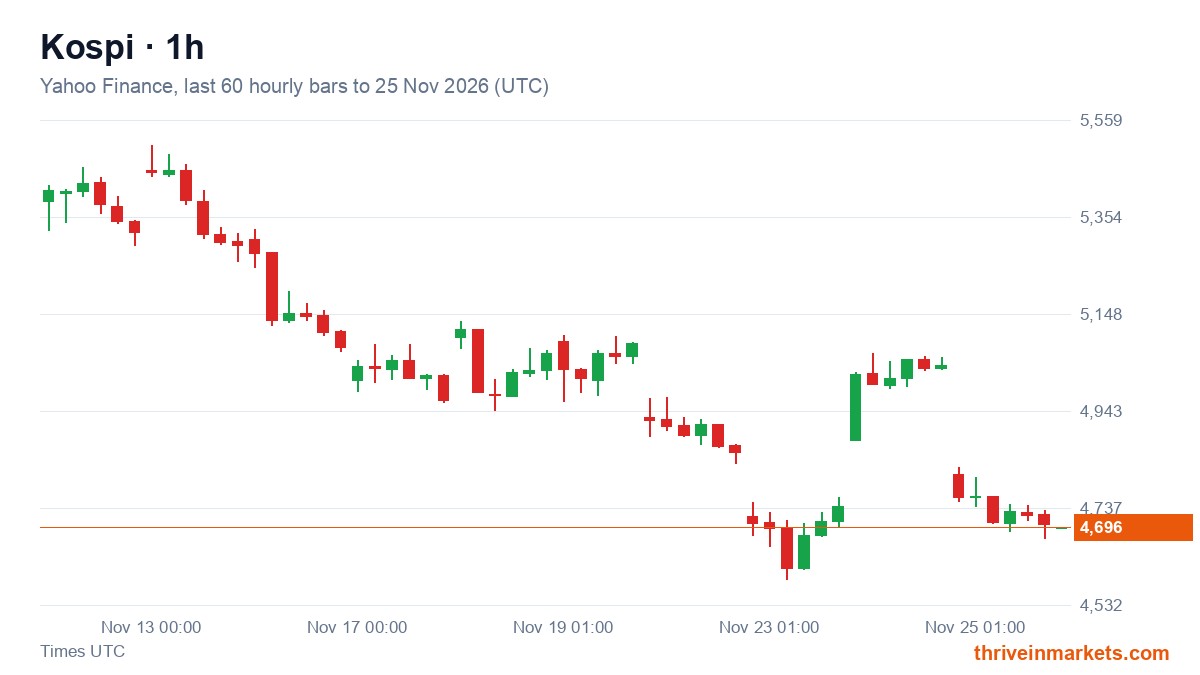
Japanese chip names followed, and SoftBank fell nearly 14%. Two worries are driving it: whether AI spending will earn its money back, and the US trade office's probe into excess industrial capacity, which is expected to bring new tariffs.
- Chipmakers led the drop in Taiwan, Korea and Japan
- Tariff findings could land today
Dell Beats, Australian Inflation Runs Hot
Dell reported after the US close and beat forecasts, with revenue of $54.9 billion and a $132 billion backlog of AI server orders. Its shares rose about 4% after hours, yet Asian chips sold off anyway, which shows how sensitive the AI trade is right now.
In Australia, October inflation hit 4.9%, a three-year high. Markets still price almost no chance of an RBA move at its December meeting, and the Australian dollar slipped about 0.6% on the risk-off mood.
- Strong AI results did not stop the chip selloff
- Hot Australian inflation did not help its currency
Gold and Oil Both Lean Lower
Gold is near $3,525, close to a 13-month low and more than 3% below Monday. Firm rate-hike bets weigh on it because gold pays no interest. Scenarios to watch: reclaiming $3,600 would steady the metal, while failing to do so keeps sellers in charge.
WTI crude is near $81, down about 1.5%, as supply worries outweigh Middle East tension and the US-Iran talks. Scenarios to watch: a close below $80 would mark a fresh three-month low.
- Gold is a rate story ahead of inflation data
- Oil is held down by growing supply
Crypto Check: Bitcoin Under $60,000
Bitcoin is near $59,100, down about 2% in 24 hours. Ether is near $1,653.
US spot Bitcoin ETFs lost another $232 million on Tuesday, the sixth straight day of outflows, taking November to a record $4.71 billion of net selling. Scenarios to watch: reclaiming $60,000 would keep the bounce alive, while a slide would bring the two-year low near $55,100 back into view.
- ETF outflows are the main pressure
- Bitcoin did not join the stock rebound earlier this week
Today's Calendar and What's Next
Deere reports before the US open at 11:30 UTC. At 13:30 UTC comes October PCE inflation, with core expected at 3.2% from 3.1%, plus the second estimate of third-quarter GDP, durable goods and jobless claims. Traders put the odds of a quarter-point Fed hike on December 9 near 95%.
EIA crude inventories follow at 15:30 UTC, and the Fed's Beige Book at 19:00 UTC. US markets are shut Thursday for Thanksgiving, so thin trading can exaggerate moves. See the full economic calendar and last night's review.
- PCE at 13:30 UTC is the main test for December Fed pricing
- A hot core reading would add pressure on gold and tech
ThriveInMarkets provides market commentary for information only. It is not investment advice or a recommendation to buy or sell any asset.