Nvidia GTC: The $1 Trillion AI Bet
Jensen Huang took the stage at Nvidia's GTC 2026 conference Monday and delivered a projection that stopped trading desks cold: purchase orders for Blackwell and the new Vera Rubin platform are expected to hit $1 trillion through 2027. That is not a product announcement. That is a declaration of infrastructure war.
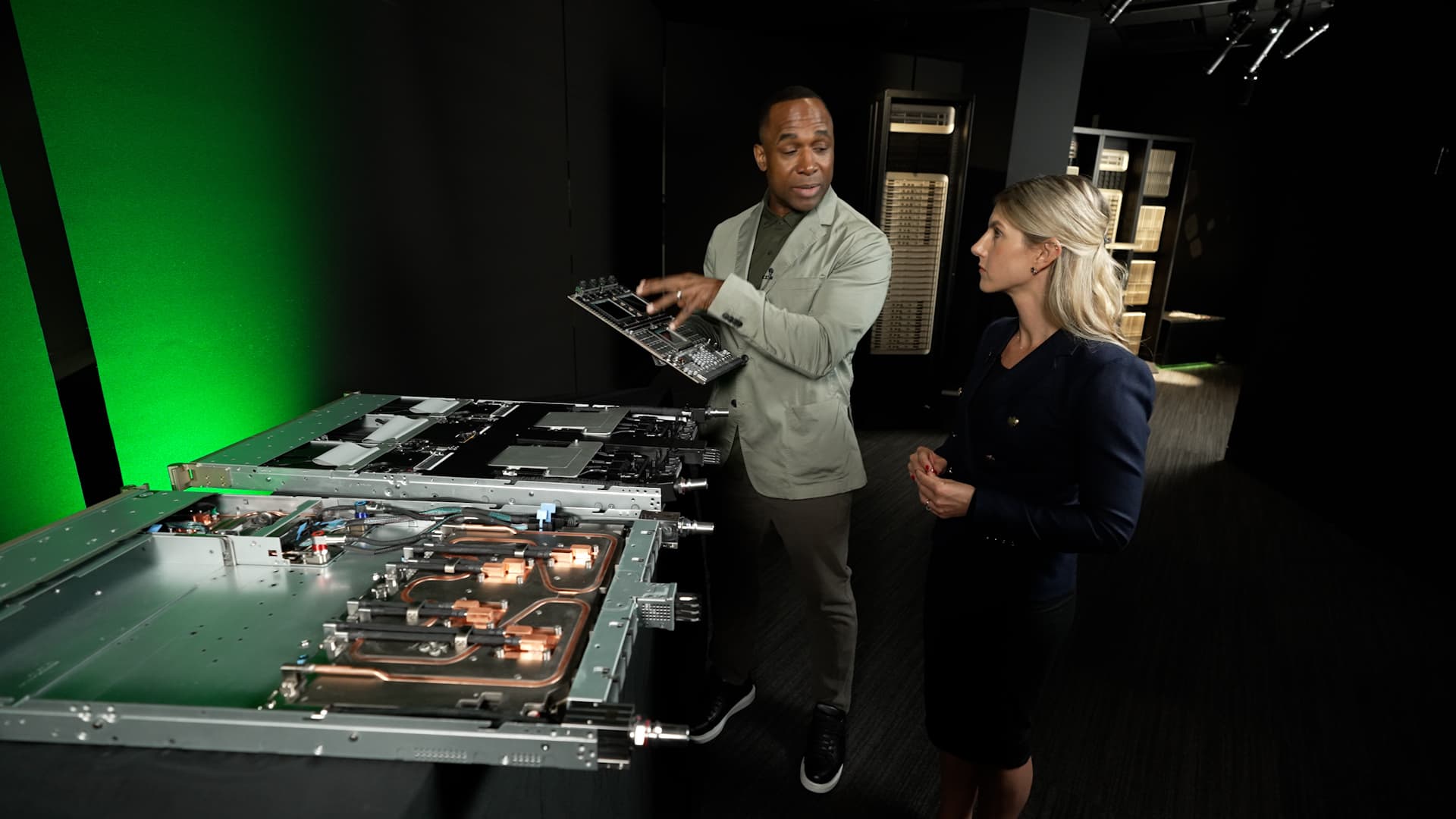
Vera Rubin is the headline hardware: a full-stack supercomputing platform comprising seven chips, five rack-scale systems, and one supercomputer purpose-built for agentic AI workloads. The Vera CPU alone delivers twice the efficiency of traditional CPUs at 50% faster throughput. Nvidia also unveiled Vera Rubin Space-1, a space-grade computing platform — which tells you everything about where AI infrastructure demand is headed.
Markets responded. NVDA gained over 3% on the session, AMD caught a bid on the rising-tide narrative, and Microsoft held firm on its Copilot restructuring toward superintelligence-focused models. The AI hardware supercycle thesis is not weakening. It is accelerating.
AI Winners vs Losers: The Market Split
Winners: Infrastructure plays dominate. NVDA, AMD, and Microsoft are the direct beneficiaries as enterprise AI capex ramps up. Amazon's CEO raised the stakes further, projecting that AI could double AWS sales to $600 billion by 2036. OpenAI is deepening its enterprise moat, closing deals to supply AI services to US government agencies via Amazon Cloud. Alibaba is rolling out agentic AI tooling. Gecko Robotics landed Navy contracts powered by AI robotics. The investment thesis here is simple: whoever builds or owns the infrastructure wins.
Losers: Traditional SaaS and mid-tier software companies are getting repriced in real time. Atlassian cut 1,600 staff, 10% of its global workforce, with over 900 cuts falling in R&D. CEO Mike Cannon-Brookes framed it as an AI-first pivot. Markets disagreed with his framing: Atlassian has lost over half its market cap year-to-date. The company is not pivoting to AI. It is being disrupted by it. Tech layoffs industry-wide have now topped 45,000 in 2026, with OpenAI's GPT-5.4 directly automating the workflows that previously required those headcounts.
The S&P 500 closed slightly positive, balancing AI-driven margin optimism against growth concerns from the layoff wave. The Nasdaq held up better than the broader market.
Bitcoin: Momentum Toward $75K
BTC is trading in the $74,000 to $74,500 range, briefly touching $75,000 before pulling back during the session. The move is being driven by a combination of continued ETF inflows, a short squeeze that liquidated over $180 million in bearish positions, and genuine demand from institutional players correlating BTC to the AI-driven digital infrastructure narrative.
The AI connection is not metaphorical. As AI workloads scale, demand for compute, energy, and decentralized infrastructure grows. Bitcoin miners and on-chain validators benefit from both energy narrative tailwinds and institutional diversification flows away from traditional assets.
The key resistance zone is $75,000 to $80,000. A clean close above $75K on strong volume would open the door to the next leg. Citigroup flagged a bear case scenario at $58,000 tied to slow US crypto legislation, but that scenario requires a significant reversal in the current institutional positioning.
Key Levels: Support at $72,000. Resistance at $75,000, then $78,000 to $80,000.
Gold and Oil: Background Noise Tonight
Gold is trading near $3,027, consolidating after recent highs as safe-haven demand holds steady but enthusiasm cools slightly from the AI-driven risk-on tone. The underlying bid from central bank buying and geopolitical uncertainty remains intact.
Brent crude is steady near $102 with no new Hormuz escalation to report overnight.
Overnight Watchlist
- BTC $75,000 breakout or rejection is the key level overnight
- NVDA follow-through in Asian and European premarket sessions
- S&P 500 6,700 as the near-term bull/bear line
- Any Fed speaker commentary ahead of next week's FOMC meeting
- Enterprise AI deal flow from OpenAI, Microsoft, or Amazon