Not financial advice. This is a project spotlight for informational purposes only. Always do your own research before making any investment decisions.
What Is Hyperliquid?
Hyperliquid is the #1 decentralized perpetual futures exchange by volume, and it is built differently from every other DEX in existence. While competitors like dYdX and GMX run on top of Ethereum or Arbitrum, Hyperliquid operates on its own purpose-built Layer-1 blockchain — HyperBFT — designed from the ground up for high-frequency trading.
Think Binance Futures, but fully on-chain. No KYC. No custodial risk. The order book is transparent and settled on-chain, but the performance matches a centralized exchange: 100,000+ orders per second, sub-second finality, and a UI that professional traders actually use.
The result is a DEX that does what most crypto projects only promise: it actually handles institutional trading volume without compromising on decentralization.
The Founder: Jeff Yan and Chameleon Trading
Jeff Yan is a Harvard math graduate who spent years running Chameleon Trading, a crypto proprietary market-making firm he founded in 2020. Unlike most DeFi founders who raised VC money to build, Yan built Hyperliquid entirely from trading profits.
That is not a small detail. It means:
- No venture capital allocation in the token supply
- No VC lockup expiry dates that trigger mass sell-offs
- No investors whose interests may conflict with the protocol's users
- A founding team with genuine market-making expertise baked into the product design
In a space littered with VC-backed projects where insiders dump on retail, Hyperliquid's self-funded origin is structurally significant. The team's incentives are aligned with the protocol's long-term success.
The S&P 500 Bombshell (March 18, 2026)
On March 18, 2026, S&P Dow Jones Indices — the world's leading index provider — officially licensed the S&P 500 to Trade[XYZ] to launch perpetual contracts on Hyperliquid. This is not an unofficial synthetic. This is the first and only officially licensed S&P 500 perpetual derivative on a decentralized exchange, backed by real-time institutional-quality index data from S&P DJI itself.
The implications are significant:
- Eligible non-U.S. investors can now trade the S&P 500 24 hours a day, 7 days a week, 365 days a year
- No broker. No account minimum. No market hours restriction.
- When geopolitical events hit on a Saturday at 2 AM, traders can act immediately — not wait for Monday's open
- The S&P 500 perpetual uses S&P DJI's real-time data, giving it the same index accuracy as exchange-traded products
S&P Chief Product Officer Cameron Drinkwater stated: "This collaboration expands access and utility of our flagship benchmarks within digital trading environments." That is institutional language for: TradFi is now officially building on Hyperliquid.
XYZ markets have exceeded $100 billion in cumulative volume since October, with an annualized run rate of over $600 billion.
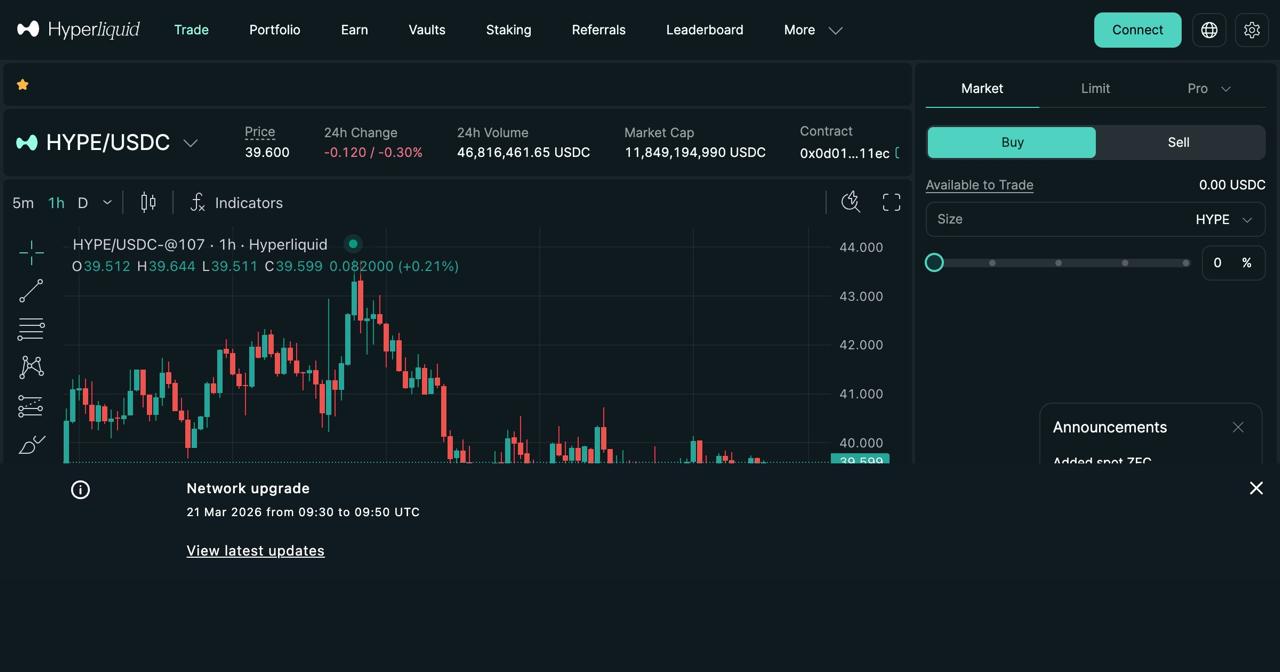
Hyperliquid's revenue flywheel: fees flow into HYPE buybacks and burns (Image: Phemex)
HIP-3: Real-World Assets Go On-Chain
The S&P 500 listing is part of a broader structural shift enabled by Hyperliquid's HIP-3 upgrade, which allows the permissionless creation of perpetual markets for real-world assets (RWA). Any asset with a reliable price feed can now have a 24/7 on-chain perpetual market.
Current RWA markets live on Hyperliquid include:
- S&P 500 — officially licensed, powered by S&P DJI data
- Crude Oil (WTI, Brent) — oil traders executed while traditional markets were closed during the Gulf conflict
- Gold and Silver — commodity perpetuals with no expiry
- Equity index futures via the XYZ100-USDC contract (peak open interest: $213M)
Every one of these markets generates trading fees. Those fees flow directly into the protocol's Assistance Fund, which executes daily buybacks of HYPE tokens. More asset markets = more volume = more fees = more HYPE burned. The flywheel is live and measurable.
Why HYPE Holds Value: Token Mechanics
HYPE is not a governance token that sits idle. It has real utility embedded in the protocol's economics:
- Fee buyback and burn: 97% of all protocol revenue flows into daily market buybacks of HYPE. Bought tokens are permanently burned — reducing circulating supply. This is not a promise; it is running live on-chain.
- Staking: Validators stake HYPE to secure the HyperBFT network and earn staking rewards.
- Governance: HYPE holders vote on protocol parameters, fee structures, and upgrades.
- Gas token on HyperEVM: HYPE is the native gas token for the HyperEVM, with an EIP-1559-style burn mechanism — every transaction permanently removes HYPE from supply.
- Revenue share through burns: Hyperliquid is currently ranked the #1 revenue-generating protocol in all of DeFi. That revenue flows back to token holders through supply reduction.
Tokenomics at a Glance
- Total supply: 1,000,000,000 HYPE (1 billion)
- Community airdrop: 31% distributed at launch (~$1 billion in value at launch prices)
- VC allocation: Zero. None.
- Circulating supply: ~238 million HYPE
- Deflationary mechanism: Daily buyback and burn via Assistance Fund
- Current price: $39.56
- Market cap: $9.4 billion (CoinMarketCap rank #10)
- All-time high: $59 (September 2025)
- 1-year performance: +225%
How Hyperliquid Compares to the Competition
| Feature | Hyperliquid | dYdX | GMX | CEX (Binance/Bybit) |
|---|---|---|---|---|
| Blockchain | Own L1 (HyperBFT) | Cosmos SDK | Arbitrum (L2) | Centralized servers |
| Order Speed | 100K+ orders/sec | ~1K orders/sec | AMM (no order book) | 100K+ orders/sec |
| VC Allocation | None | Yes (large) | None | N/A (equity) |
| S&P 500 Perp (Licensed) | Yes (exclusive) | No | No | No |
| RWA Markets (HIP-3) | Oil, Gold, Equities | No | No | No |
| Fee Buyback & Burn | 97% of revenue | Partial | Yes (GLP) | No (equity model) |
| KYC Required | No | Some jurisdictions | No | Yes |
| Revenue Rank (DeFi) | #1 | Top 20 | Top 10 | N/A |
The Revenue Flywheel in Numbers
This is not theoretical. Hyperliquid is generating more protocol revenue than almost any other DeFi application in existence. The flywheel operates as follows:
- Traders use Hyperliquid for perpetual futures (crypto, RWA, S&P 500)
- Trading fees accumulate in the Assistance Fund
- 97% of fees execute daily market buybacks of HYPE at current market prices
- Purchased HYPE is permanently burned, reducing total supply
- Higher volume = more fees = more buybacks = lower circulating supply = structural price support
At the time of writing, Hyperliquid's daily trading volume regularly exceeds $500 million to $1 billion. With fee rates in the range of 0.02-0.05% per trade, the Assistance Fund is accumulating hundreds of thousands of dollars in daily buyback capacity. Every day.
Risks to Consider
No project spotlight is complete without an honest look at the downside scenarios:
- Token concentration: Despite the 31% community airdrop, a significant portion of supply remains with the founding team. Large insider movements could create selling pressure.
- SEC regulatory risk: The officially licensed S&P 500 perpetual is only available to non-U.S. eligible investors. The SEC may still take action against platforms offering equity derivatives to American users, even if accessed outside the U.S.
- Own L1 smart contract risk: Running on a proprietary blockchain means the security model is less battle-tested than Ethereum. A novel exploit on HyperBFT would have no Ethereum security guarantees to fall back on.
- Competition intensifying: Coinbase launched stock perpetual futures for non-U.S. customers on March 20, 2026 — two days after the S&P 500 Hyperliquid announcement. The RWA derivatives space is getting crowded fast.
- Price ran fast: Up 225% over the past year and down from the $59 ATH. Momentum can reverse. A return to risk-off sentiment could pressure HYPE significantly.
Key Links
- Hyperliquid Official Platform
- HYPE on CoinGecko
- Hyperliquid on X
- Official S&P 500 License Press Release
- CoinDesk: S&P 500 Moves On-Chain
The Bottom Line
Hyperliquid is the most credibly built DEX in crypto. It has performance that matches centralized exchanges, tokenomics that genuinely benefit holders rather than insiders, and — as of March 18, 2026 — an officially licensed S&P 500 perpetual contract that no other decentralized platform can offer.
The S&P 500 licensing is not a gimmick. S&P Dow Jones Indices does not hand out its flagship benchmark to random projects. The fact that they chose Hyperliquid says something real about the platform's credibility, infrastructure, and trajectory. This is TradFi institutions beginning to build on-chain — and they chose Hyperliquid to do it.
At $39.56 with a $9.4 billion market cap, HYPE is already a large-cap token. The easy money from early adopters has been made. The question now is whether the S&P 500 licensing marks the beginning of a structural expansion in RWA derivatives volume, and whether Hyperliquid can maintain its lead as competition intensifies. Arthur Hayes, for what it is worth, has a $150 price target.
Not financial advice. Always do your own research.