Morning Snapshot — 05:00 UTC
Friday morning and the dust from one of the most consequential weeks in recent energy history has not settled. Brent crude holds above $114. WTI trades near $98 — the Brent-WTI spread at an 11-year high signals supply dislocations that the US market can partly absorb but Europe and Asia cannot. Gold pulled back to $4,536 after last week's $5,000+ peak, still up nearly 50% from a year ago. Bitcoin is essentially flat at $70,750. The Fear and Greed Index collapsed to 11 — Extreme Fear.
- BTC: $70,750 (-0.18% 24h)
- ETH: $2,146 (-2.19% 24h)
- Gold (XAU/USD): $4,536 (down from $5,012 highs, -9.5% from peak)
- Brent Crude: $114+ (briefly $119 on Thursday)
- WTI Crude: ~$97-98/bbl
- Fear & Greed Index: 11 — Extreme Fear
South Pars / Ras Laffan: The Damage That Will Last Years
The physical damage from this week's strikes is not a short-term story. Israel hit South Pars — the world's largest natural gas field — on Wednesday. Hours later, Iran fired ballistic missiles at Qatar's Ras Laffan Industrial City, the world's largest LNG export facility. QatarEnergy CEO Saad al-Kaabi confirmed the damage is extensive: 17% of Qatar's LNG export capacity is offline. Analysts estimate the rebuild takes 3 to 5 years at a cost of roughly $20 billion in annual revenue to Qatar.
Qatar is the world's second-largest LNG exporter after the US, supplying approximately a fifth of global LNG shipments. Europe's energy security — already under stress since 2022 — just took another structural hit. European gas prices soared 35% on the news. The IEA has already released 400 million barrels from emergency reserves (agreed March 11), but that only addresses crude, not gas or LNG.
Trump moved quickly: he posted that the US "knew nothing" about Israel's South Pars strike and urged Israel to stop unless Iran attacks Qatar again — in which case the US would "massively blow up the entirety of South Pars." The ceasefire needle, for now, has not moved. Iran expelled Qatari diplomatic staff. Qatar declared Iranian military attachés persona non grata. The Gulf is rearranging.
IEA estimates and Goldman Sachs' regression models both flag Brent could average $150/barrel over six months if the conflict continues at current intensity. That is the tail risk keeping oil traders defensive heading into the weekend.
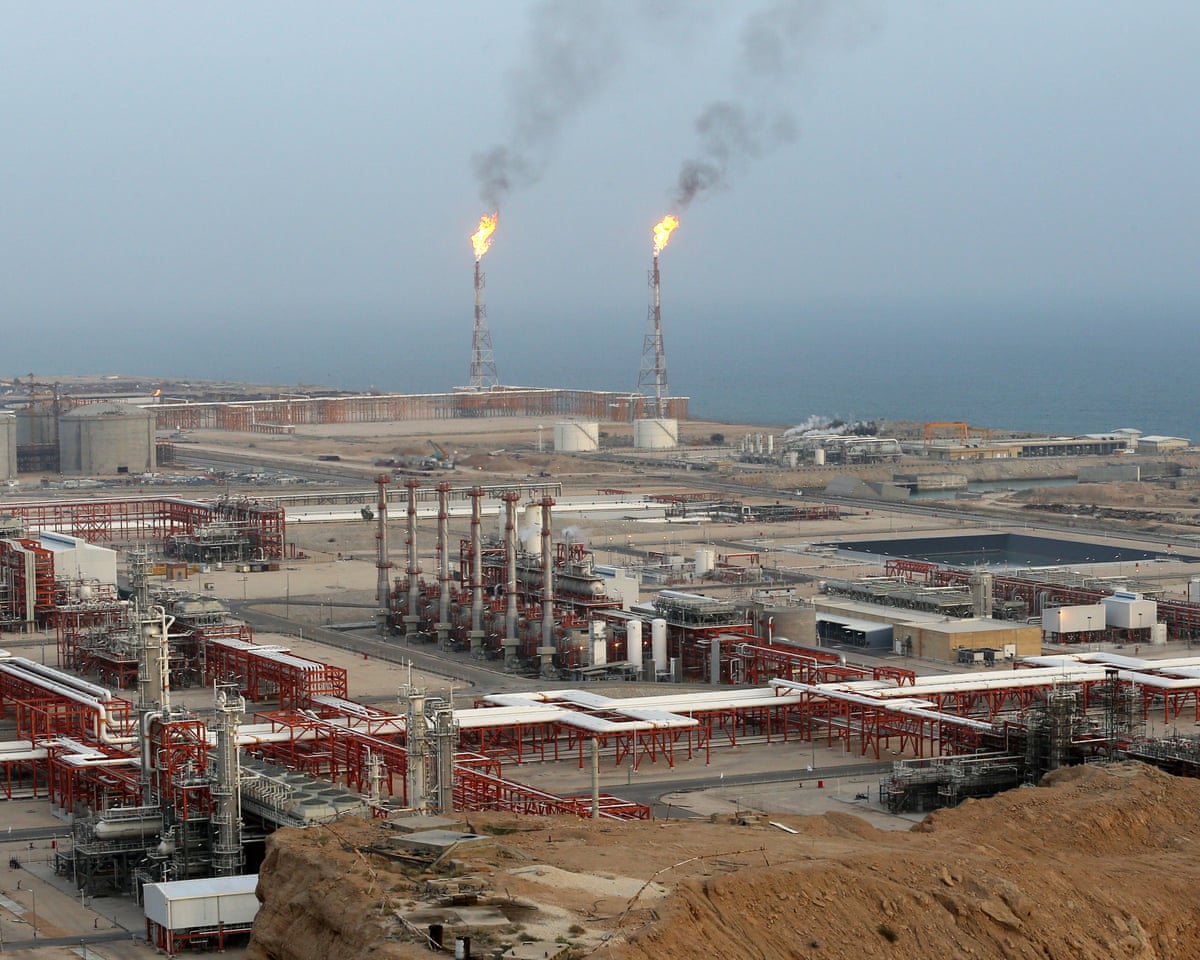
Iran's IRGC threatened multiple Gulf energy facilities after Israel struck South Pars. (The Guardian / Reuters)
Fed Aftermath: Rates Frozen, Inflation Rising
Wednesday's FOMC decision delivered the expected hold at 3.5%-3.75%, but the details were more hawkish than markets wanted. The dot plot's median projection still shows one cut in 2026. The CME FedWatch Tool, however, shows no cut priced until mid-2027 — markets are simply not believing Powell's optimism on inflation progress.
The numbers backing that skepticism: the Fed revised PCE inflation to 2.7%, up from 2.5%. PPI for February came in at 0.7% — more than double the 0.3% forecast. Core PPI hit 3.9%, its highest since February 2023. The 10x Research model projects that $114 oil will push CPI from 2.43% toward 3.4% — a long way from the Fed's 2% target.
Powell acknowledged the bind explicitly: "The risks to the labor market are to the downside, which would call for lower rates. The risks to inflation are to the upside, which would call for no rate cut until inflation cools." That is the definition of being stuck. Until oil prices fall or the war ends, the Fed is frozen. And a frozen Fed at 3.75% with $114 oil and sticky inflation is the textbook macro setup for what comes next.
Stocks and ETFs to Watch: The Stagflation Playbook
War plus $114 oil plus a hawkish Fed equals stagflation. Bank of America flagged this explicitly last week. In this environment, sector rotation is not subtle — it is aggressive and structural. Here is where the money is moving.
Winners
XLE (Energy Select Sector SPDR) — Buy the macro tailwind
The most direct equity play on $100+ oil without the volatility of crude futures. ExxonMobil and Chevron together represent ~41% of the fund. At $114 Brent, these companies are generating record free cash flow, buying back shares, and paying 3-4% dividend yields. XLE is up roughly 27% YTD in 2026, outperforming every other S&P 500 sector. Even if a ceasefire drops oil to $90, XLE remains fundamentally sound. Individual names to watch: XOM, CVX, COP, EOG.
ITA (iShares Aerospace and Defense ETF) — Ceasefire-proof spending
Defense budgets do not reverse when wars end. NATO commitments are locked in. US defense spending is increasing regardless of what happens in the Gulf next week. Top holdings GE Aerospace, RTX, and Boeing together account for ~45% of the fund. Lockheed Martin's F-35 backlog stretches into the 2030s. Individual names: LMT, RTX, NOC, GD. This is the most durable trade in the current environment — supply contracts outlast headlines.
GLD (SPDR Gold Shares) — The dual-scenario hedge
Gold wins in both directions from here. War escalation drives safe-haven demand. But even if a ceasefire happens tomorrow, the $20B annual revenue hole from Qatar's offline LNG capacity means energy inflation stays embedded — and a stuck Fed cannot cut aggressively enough to hurt gold. The pullback from $5,012 to $4,536 is not a bearish reversal; it is a post-FOMC dollar-strength correction. Central banks continue buying. GLD hit $180B AUM with nearly $15B in Q1 inflows. The long-term bid is structural.
Losers
QQQ (Invesco Nasdaq 100) — Structural headwind
Tech is facing a dual squeeze that does not resolve quickly. Rising inflation means higher discount rates for future earnings — tech stocks priced on 5-10 year cash flows are most exposed to this. The Fed staying at 3.75% with no cut in sight is toxic for growth multiples. QQQ also suffers from war-driven risk appetite contraction: when uncertainty spikes, high-beta assets get sold first. Individual names under pressure: AAPL, NVDA, TSLA, META, AMZN. Wait for a clear macro pivot before adding QQQ exposure.
XLY (Consumer Discretionary) — $114 oil is a consumer tax
When households spend more at the gas pump and grocery store, Amazon orders, car purchases, and home improvement projects get cut. XLY's top holdings — Amazon, Tesla, Home Depot — are all exposed to exactly this dynamic. Stagflation is a double hit: prices rise while spending power falls. XLY dropped 2.3% on March 16 alone as fuel prices surged. The sector faces both "higher for longer" rates AND rising energy costs simultaneously. Avoid.
The macro frame: War + $114 oil + hawkish Fed = stagflation. Winners: energy (XLE), defense (ITA), gold (GLD). Losers: tech (QQQ), consumer discretionary (XLY), crypto (short-term). This rotation is already happening — not a prediction, an observation.
BTC and Crypto: Risk Asset, Not Safe Haven
Bitcoin's flat performance at $70,750 masks the underlying weakness. The asset peaked near $84K in late February before the Iran conflict began, and has shed roughly 16% since. The Fear and Greed Index at 11 — Extreme Fear is a historic low that often marks accumulation zones in crypto cycles. But macro headwinds override historical pattern recognition when the environment is genuinely novel.
BTC is trading as a high-beta risk asset, not digital gold. The correlation with QQQ remains tight. Ethereum's worse 24h performance (-2.19% vs BTC's -0.18%) confirms the risk-off dynamic — capital concentrates in BTC, not altcoins, during stress.
Key levels: $69,500-$70,000 is the support cluster. A daily close below $69,500 opens the path toward $67,500-$68,000. On the upside, BTC needs to reclaim $72,500 convincingly before the bearish bias shifts. Weekend liquidity risk remains elevated given open geopolitical tail risks.
Gold (XAU/USD): $4,536 and Structurally Bid
Gold's drop from $5,012 to $4,536 looks alarming on a chart but is straightforward mechanically: post-FOMC dollar strength reduced the dollar-denominated price of gold. The pullback is real — nearly 10% from peak — but context matters. A year ago gold traded at $3,031. The 52-week high is $5,478. The current price is still 52% above the 52-week low.
The structural bid remains intact. Three drivers: (1) central bank buying at record pace, (2) war premium from Gulf energy infrastructure risk, (3) Fed-frozen environment means real yields stay contained. The $4,500-$4,536 zone is the first support. Below that, watch $4,400 and the 20-day moving average. A re-test of $5,000 is the medium-term upside target if either war escalation or a Fed softening materializes.
Economic Calendar — Key USD Events Today (UTC)
- Friday, March 20 — No major scheduled USD data releases. Markets are watching geopolitical newsflow, oil pricing, and weekend positioning rather than data catalysts.
- Fed speakers: Post-FOMC blackout typically lifts Friday after the meeting week. Any dovish deviation from Powell's tone would be significant for rate expectations.
- End-of-week positioning: Traders will reduce exposure heading into the weekend given open geopolitical risk. Expect thin liquidity in the US afternoon session.
What to Watch Today
- Iran headlines: Any new strikes or confirmed ceasefire talks are the highest-impact catalyst. Gulf weekend = risk of low-liquidity oil spike.
- Brent $114 holds or breaks: A move toward $120 reignites inflation fears. A drop toward $108-$110 on ceasefire signals would be risk-on.
- BTC $69,500 support: The level that matters most for crypto this week. A close above maintains the range. A close below shifts bias firmly bearish.
- Gold $4,500: Watch for a test of this round-number level. Strong buy-side demand here from central banks and ETF flows would confirm support.
- XLE and ITA performance: Energy and defense stocks opening higher would confirm the sector rotation is accelerating. Any gap-up in XOM or LMT is a real-time signal.
- USD/DXY: Dollar strength post-FOMC remains a headwind for commodities. Watch the 104.5-105 zone. Any softening here is constructive for gold.
- VIX: Hit 25.09 on Thursday. If it stays elevated into the weekend, expect continued defensive positioning across equity markets.