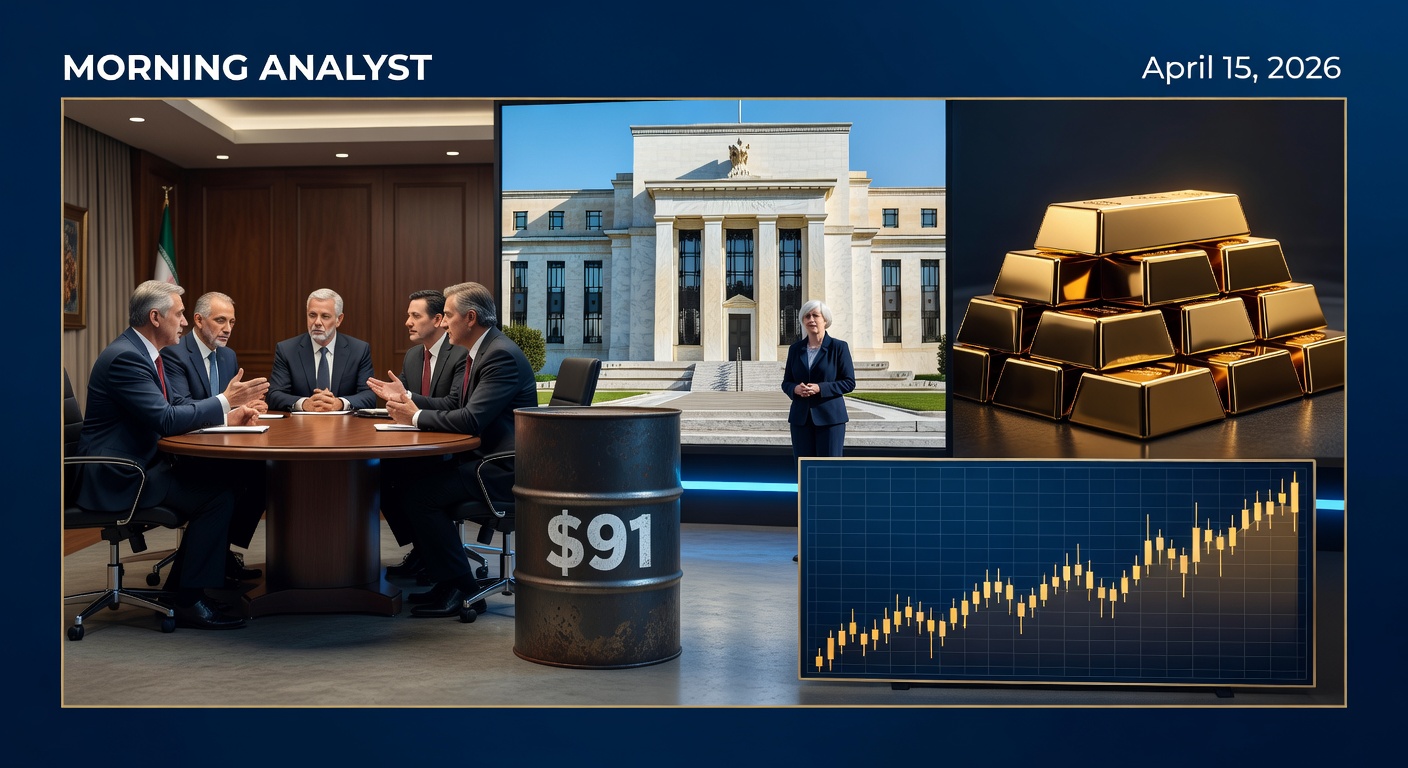
1. Second round of U.S.-Iran talks taking shape -- oil at $91 as diplomacy resumes
After the Islamabad talks collapsed on April 11, the U.S. military activated its port blockade against Iranian exports on April 12. Within 48 hours, officials from both Washington and Tehran were discussing a second round of negotiations. The White House confirmed Tuesday that more talks are under discussion, with Pakistani intermediaries again serving as the channel. Bloomberg's oil desk reported Wednesday morning that the blockade is being read by energy markets as a targeted pressure tool, not a permanent escalation -- an interpretation consistent with WTI's retreat from the $103.45 blockade peak.
Key sticking points remain unchanged: Iran's right to nuclear enrichment and control of the Strait of Hormuz. Neither is close to resolution. But the fact that both sides are talking before the original two-week ceasefire window fully expires matters for market pricing. For the full context on how the blockade was announced and oil's initial reaction, see the April 13 morning analysis and yesterday's post.
- Second round of talks under discussion -- no venue or date confirmed yet; the market is pricing in the possibility, not the certainty
- Blockade framed as pressure tool -- that interpretation is doing the most work in oil's pullback from $103 to $91
- Nuclear enrichment and Hormuz control remain unresolved -- each of these issues alone is capable of collapsing the next round
- Ceasefire window expires April 21 -- deadline pressure cuts both ways; urgency pushes both sides toward a deal and toward brinkmanship
2. Gold at $4,824 -- Yellen endorses a Fed cut and central banks keep buying
Janet Yellen, former Treasury Secretary and ex-Federal Reserve Chair, told Bloomberg on Wednesday that she still sees prospects for a U.S. rate cut in 2026 despite the oil shock clouding the inflation outlook. The effective funds rate sits at 3.64% (target range 3.5-3.75%). The next FOMC meeting is April 28-29, widely expected to hold steady, but Yellen's view is that the energy disinflationary lag -- when lower oil prices finally hit CPI data -- will create the opening for a cut later this year.

Yellen's Wednesday Bloomberg interview is among the clearest high-profile dovish signals since the oil shock began.
Gold is up 1.2% to $4,824, building on the structural bid from central bank accumulation. The People's Bank of China reported 16 consecutive months of net additions through April 2026, with official reserves reaching approximately 2,309 tonnes. Gold has now recovered the full pullback from Tuesday's intraday lows and sits near the top of the $4,817-$4,872 session range.
- Yellen backs a 2026 cut -- rare credible dovish signal from outside the Fed; markets had priced near-zero cuts before this week
- FOMC April 28-29 expected to hold -- but the policy direction conversation has shifted; watch for any dissent language in the statement
- Gold at $4,824, range $4,817-$4,872 -- structural bid from central banks forms the floor beneath every geopolitical swing
- $4,800 holding, $5,000 is the next target -- as long as PBoC accumulation and the rate-cut narrative stay intact
3. Bitcoin at $73,967 -- CLARITY Act markup window opens and MSBT ETF gains traction
Bitcoin is consolidating at $73,967 after Tuesday's four-week high of $74,484. The pullback is orderly -- no significant ETF outflows, no panic selling. CoinDesk noted that BTC briefly tested the $75,000 breakout level before reversing; funding rates on perpetual futures have been negative for 46 consecutive days even as open interest rises, a setup that historically precedes sharp upside moves. The positioning is more bearish than the price.
The legislative catalyst is advancing in parallel. The CLARITY Act -- covering token classification, SEC/CFTC jurisdiction, and DeFi oversight -- is moving toward Senate Banking Committee markup by end of April. Missing this window pushes the bill past midterms. Morgan Stanley's Bitcoin Trust (MSBT) launched Tuesday at a 0.14% expense ratio, undercutting BlackRock's IBIT at 0.25%, with first-day inflows of $31-34 million. Ethereum held at $2,332 (-1.8%) during Bitcoin's consolidation.
- BTC at $73,967 (-0.7%) -- orderly digest of the Tuesday high; patient buyers remain underneath
- CLARITY Act markup by end of April -- the clearest near-term legislative catalyst for crypto markets this cycle
- MSBT at 0.14% fee -- fee compression accelerates; expands the addressable institutional market long-term
- $72,000 is the key support level -- holds it and consolidation is healthy; breaks it and the market retests $70,000
4. S&P 500 at 6,967 -- earnings season digests JPMorgan's beat-and-guide-down
The S&P 500 closed at 6,967 on April 14 -- up 1.18% for the session -- even as JPMorgan Chase fell 3% after beating Q1 EPS at $5.94 vs. the $5.46 consensus, but then trimming full-year NII guidance to $103 billion. The broad index absorbing a 3% drop in the largest U.S. bank while still closing materially higher signals genuine underlying breadth. S&P futures indicated approximately 7,010 at Wednesday's open, a further +0.6% extension. Asian markets rose overnight as the Iran diplomacy narrative strengthened.
BlackRock's April 14 results provided the cleaner beat: $135.9 billion in Q1 long-term inflows, AUM at $13.9 trillion, and EPS up 46%. The divergence -- JPMorgan trimming NII guidance on yield curve dynamics while BlackRock accelerates inflows -- reflects how differently bank revenues and asset management businesses are exposed to the current rate and geopolitical environment. For fuller earnings context, see the April 14 market roundup.
- S&P 500 at 6,967 (+1.18%) -- absorbed JPMorgan's 3% drop and still rallied; the recovery thesis is broadening beyond mega-cap tech
- Futures at ~7,010 -- 7,000 is the psychological level to close above cleanly; watch the end-of-day print
- JPMorgan EPS beat, NII guide cut -- the emerging template for bank earnings this season: strong quarter, cautious year-ahead
- BlackRock $135.9B inflows -- institutional capital continues moving into markets despite the geopolitical overhang
5. What $91 oil says about the next 30 days
WTI at $91.30 sits almost exactly at the midpoint between the pre-conflict baseline (~$68) and the blockade-announcement peak ($103.45). That price is the market's mathematical expression of partial, contested Hormuz access -- neither free flow nor permanent closure. The 800-vessel tanker backlog cannot clear quickly; even after a formal deal, supply normalization is a months-long process. Shipping insurers are still applying war-risk premiums that effectively cap the pace of any reopening.
From $91, the upside risk (full breakdown, Hormuz closed) is larger than the downside (full deal, oil toward $75-80 on normalization). But the downside is more probable the longer diplomacy continues. Markets are pricing the messy middle: an $87-97 range for the next 30 days, with every Iran briefing moving oil 2-4% instantly in either direction.
- $87-97 is the 30-day range markets are pricing -- not $70 (full deal) and not $115 (full closure)
- Tanker backlog still 800 vessels -- supply normalization takes months even after a formal agreement is reached
- Every Iran headline moves oil 2-4% instantly -- volatility persists regardless of the diplomatic trajectory
- XLE (Energy Sector ETF) -- bid on ceasefire deterioration, sold on deal progress; currently in neutral territory at $91 oil
What to Watch Today
- Iran-U.S. talks (All Day): Any announcement of a second-round venue, date, or mediator is an immediate oil catalyst of 3-5%. Watch for statements from Vance, Witkoff, or Iran's Foreign Minister. IMPACT: EXTREME.
- Fed speakers: With FOMC on April 28-29, any voting member speaking today will be read against Yellen's dovish endorsement. A hawkish counterpoint would pressure gold and reprice rate-cut odds lower. IMPACT: HIGH.
- U.S. Retail Sales (12:30 UTC): Consumer spending data provides the next read on whether the oil shock is crimping domestic demand. A soft print supports the rate-cut case; a hot print complicates it. IMPACT: MEDIUM-HIGH.
- Empire State Manufacturing Index (12:30 UTC): Leading indicator for industrial activity. Consensus around -10.0. A worse-than-expected read adds to recession concern; a beat supports the soft-landing narrative. IMPACT: MEDIUM.
- CLARITY Act developments: Any Senate Banking Committee announcement on the markup timeline could trigger a 3-5% move in BTC and ETH. Watch CoinDesk and Bloomberg crypto for floor reporting. IMPACT: HIGH.
For trading gold, oil, and crypto through the Iran headline risk and the upcoming FOMC meeting with defined risk and tight spreads, Bybit's TradFi platform offers USDT-margined XAU/USD, WTI crude, and BTC perpetuals -- useful for navigating binary geopolitical and macro events. See yesterday's morning analysis for the context on the Iran blockade and JPMorgan earnings that set up today's session.