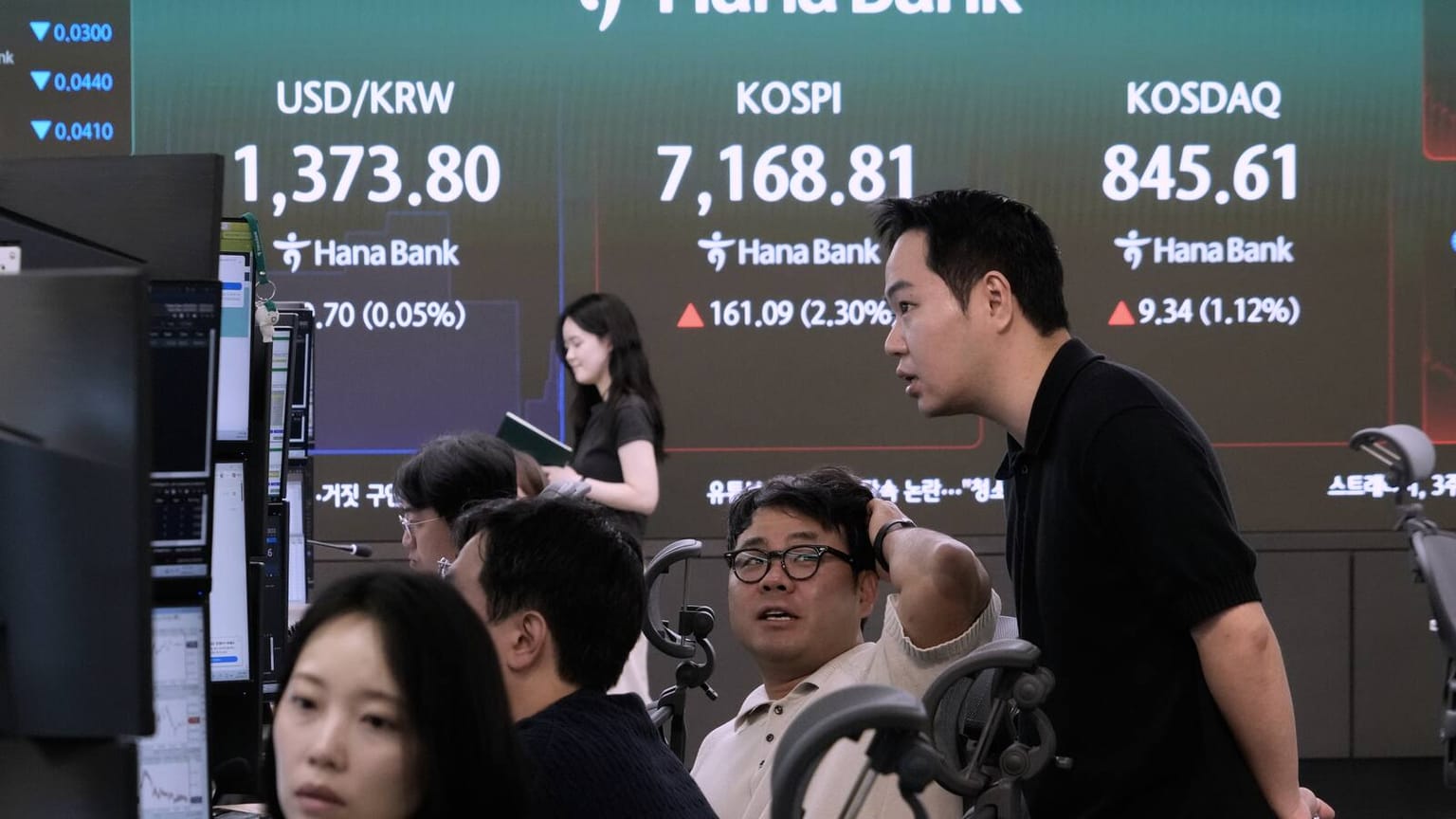
The week's selloff went global overnight. After four straight Nasdaq declines, the rout in AI and chip stocks spread across Asia and dragged US futures lower into Friday. South Korea's KOSPI plunged more than 8 percent, Japan's Nikkei dropped over 4 percent, and S&P 500 futures slid about 0.7 percent toward 7,305 while Nasdaq-100 futures fell roughly 1.3 percent. The AI-cost anxiety flagged in last night's evening review hardened into a genuine risk-off move, and the relief that Micron's blowout briefly bought earlier in the week has now fully evaporated.
The Overnight: A Global Tech Rout
This was contagion, not a single-market wobble. The KOSPI's drop triggered a 20-minute circuit breaker for the second time this week, the fifth trading halt the Korea Exchange has imposed this year, as investors fled the chipmakers that led the prior AI rally. The damage rippled outward: Hong Kong's Hang Seng fell about 1.6 percent and China's Shanghai Composite slid 1.6 percent, while the Nikkei's more than 4 percent decline confirmed the selling was regional rather than stock-specific. As Investing.com reports, the move reversed earlier AI-driven gains as traders reassessed the cost of building out artificial intelligence infrastructure. With quarter-end approaching, the impulse to trim crowded technology exposure is feeding on itself.
- KOSPI plunged over 8%, triggering a second circuit breaker this week
- Nikkei fell over 4%; Hang Seng and Shanghai each off about 1.6%
- S&P 500 futures down about 0.7% toward 7,305; Nasdaq-100 futures off roughly 1.3%
- The selling is regional contagion, not a single-stock story
- Quarter-end de-risking is amplifying the move out of tech
Story of the Day: Apple Hikes and an OpenAI Wobble
Two threads tightened the screws on AI sentiment. First, Apple fell about 6 percent on Thursday after raising prices on the Mac and iPad, citing higher memory and component costs, the same chip-price surge that lifted Micron now reframed as a margin and demand problem across consumer hardware. Second, reports of a possible delay to OpenAI's public listing rattled a market that had been pricing the AI buildout as an unstoppable one-way trade. Together they crystallized the week's core fear: that the cost of AI is climbing faster than the returns. Micron's record guidance, covered in yesterday's morning analysis, proved memory demand is real, but it could not hold a tape now fixated on who pays for it. Chip names like Sandisk and Applied Materials had rallied on Micron, yet the megacaps led the broad index lower.
- Apple dropped about 6% on Mac and iPad price hikes tied to chip costs
- A reported OpenAI IPO delay dented the one-way AI narrative
- The market's worry: AI costs are rising faster than returns
- Micron's blowout could not offset the megacap-led selling
- The rout has now run for a fourth straight session
The Dow Reshuffle: Alphabet In, Verizon Out
Against that backdrop, the blue-chip index is about to get more tech, not less. S&P Dow Jones Indices will add Alphabet and remove Verizon from the Dow Jones Industrial Average before the June 29 open, a change announced on June 23 that ends Verizon's roughly 25-year run in the 130-year-old gauge. As CNBC explains, the Dow is price-weighted, so Verizon's low share price gave it only about half a percentage point of influence, while Alphabet will carry far more sway alongside Nvidia, Amazon, Apple and Microsoft. The timing is striking: the index is deepening its megacap-tech tilt at the exact moment that tilt is causing the most pain. It raises the stakes for how the Dow behaves once Alphabet's heavier weighting lands next week.
- Alphabet replaces Verizon in the Dow before the June 29 open
- The swap ends Verizon's roughly 25-year run in the index
- The price-weighted Dow will lean further into megacap tech
- Alphabet joins Nvidia, Amazon, Apple and Microsoft in the gauge
- The change raises the Dow's tech sensitivity just as tech sells off

Crypto: Bitcoin Steadies Near $60,000
Digital assets are holding their footing for now, even as the equity tape buckles. Bitcoin sat roughly flat near $60,422 over the past 24 hours, clawing back a little ground after dipping to a multi-year low around $58,000 midweek, while Ethereum steadied near $1,580, up about 0.6 percent on the day but still bruised over the week. The pressure has come from spot ETF outflows, worries over a delayed CLARITY Act, and money rotating first out of crypto and into AI stocks, a flow now reversing as those same AI names sell off. In a true risk-off impulse the majors still trade as high-beta equities rather than havens, so the $60,000 round number is the key reference zone. A daily hold above it keeps the structure merely bruised; a slip back beneath $58,000 would reopen the week's lows.
- Bitcoin roughly flat near $60,422, off a midweek low around $58,000
- Ethereum steadied near $1,580, up about 0.6% on the day
- Drivers: ETF outflows and CLARITY Act uncertainty
- Crypto still trades as a high-beta risk asset, not a haven
- Reference zone: $60,000; a break of $58,000 reopens the lows
Gold Holds, Oil Stays Heavy
The commodity tape split along the risk-off line. Spot gold held just above $4,000 near $4,028, down only about 0.1 percent, as a firmer safe-haven bid from the global stock rout offset the drag of steady real yields, keeping the metal pinned to the psychological mark it reclaimed this week. Crude told the opposite story from the supply side: WTI stayed below $70 at about $69.76, a fourth straight session under the line, as increasing tanker traffic through the Strait of Hormuz and continued US-Iran peace progress ease the threat of disruption. As CNBC notes, more vessels are transiting Hormuz with tracking signals on as confidence in a lasting agreement grows. For gold, $4,000 is the floor to watch; for crude, $70 is now overhead resistance.
- Gold held above $4,000 near $4,028 on a firmer risk-off bid
- $4,000 remains the key floor to watch on any pullback
- WTI stayed below $70 at about $69.76, a fourth session lower
- More Hormuz tanker traffic and US-Iran progress cap crude
- Crude reference: $70, now overhead resistance
What to Watch Today
Friday is a quarter-end session layered on top of a global risk-off move, a combination that can exaggerate flows in both directions. The first question is whether the US cash open extends the overnight rout or stabilizes once the futures gap is digested and rebalancing flows clear. Bullish trigger: futures steady, chips find a bid as quarter-end positioning passes, and the megacaps stop leading lower. Bearish trigger: the cash session extends the selloff with Apple and the AI names dragging the Nasdaq down for a fifth straight day. Invalidation for the calmer case: a fresh leg lower in Asian-style contagion bleeding into US tech. In crypto, the test is simple: can Bitcoin defend $60,000, or does it slide back toward the $58,000 lows. Treat every level here as a technical reference point, not an instruction.
- A quarter-end session sits on top of a global risk-off move
- Key question: does the US cash open extend or stabilize the rout
- Bullish trigger: futures steady and chips find a bid post-rebalance
- Bearish trigger: a fifth straight Nasdaq decline led by Apple
- Crypto test: can Bitcoin defend $60,000 or slip toward $58,000
ThriveInMarkets publishes market commentary for general information only and does not provide personal investment advice. Prices are live or last-close levels as labeled and move quickly; levels cited are technical reference points, not instructions to buy or sell any asset.