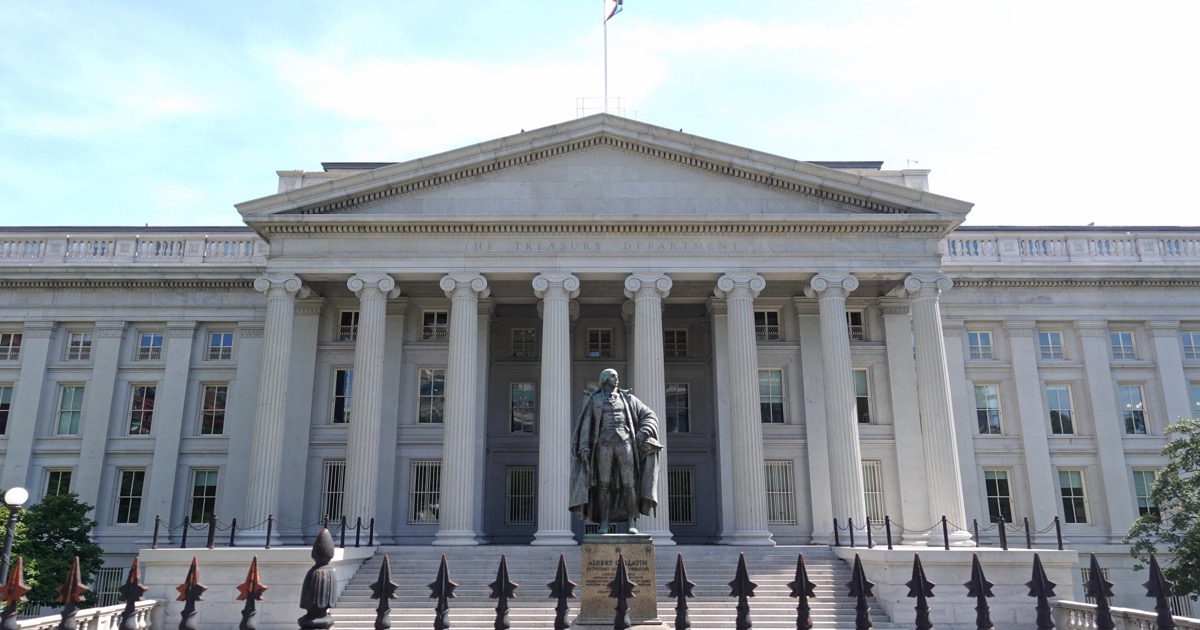
A reset that cancels the $40 trillion is not what the tape shows. What has started is a smaller change in how Washington borrows: fewer new long bonds, more short-term bills, larger buybacks, and a new set of stablecoin buyers. That can change who sets the interest rate. It does not retire the debt.
The prompt for this piece is a Bravos Research video posted on 22 September 2026, America is About to Reset Its $40 Trillion Debt Problem. The channel calls the maneuver a Treasury twist. The numbers below come from the Treasury's Debt to the Penny file, the June Monthly Statement of the Public Debt, the Congressional Budget Office, Treasury International Capital, and Treasury's own description of the buyback program.
What the video is actually claiming
Bravos is not describing a new currency, a default, or a debt jubilee. The narrator says Treasury Secretary Scott Bessent has never laid the whole plan out, and then reads three moves as one strategy.
First, buy back the long bonds. In the video, Bessent doubles long-term buybacks to $4 billion an operation, says $4 billion is a floor, and opens the government's checking account, roughly $1 trillion, to pay for more. Second, stop growing long-term auctions and replace that borrowing with bills. The video says coupon auction sizes have been unchanged for nine quarters, while bill auctions have gone from about $47 billion in 2016 to about $94 billion. Third, use the GENIUS Act, from July 2025, so that a dollar stablecoin has to be fully reserved. Bravos treats that reserve rule as a standing bid for short-term Treasuries, especially from people in Turkey, Argentina, and other countries whose own currencies have collapsed. The video puts stablecoin Treasury holdings at $120 billion today and $1.2 trillion by 2030.
The last beat is the constraint. The twist only works if the Federal Reserve keeps short-term rates low. The video says the Fed is raising rates against the White House, and that a fight over the Fed's independence is where the dollar takes the hit.
- The video describes a funding twist, not a cancelled debt
- Three pieces: long-bond buybacks, more bills, stablecoin reserves
- The plan needs a Federal Reserve that keeps short rates low
What the official numbers say
The headline debt is real. On 24 September 2026 the Treasury's Debt to the Penny file showed $40,068,807,991,924.84 outstanding. Of that, $32.36 trillion is held by the public and $7.71 trillion is owed to the government's own trust funds. The second pile is Social Security and other government accounts. It is not a bond an auction has to sell tomorrow. The Joint Economic Committee's debt monitor puts the increase over the prior year at about $7.1 billion a day. In the June Monthly Statement of the Public Debt the statutory limit was $41.104 trillion.
The buybacks are real, and they are smaller than the video's framing. On 19 August the Treasury raised the cap on long-bond liquidity buybacks from $2 billion to at least $4 billion an operation, effective 9 September through 4 November. Bessent told CNBC the size could be more than $4 billion. Bloomberg reported that the 9 September operation was sized at up to $6 billion, triple the old $2 billion cap. A $6 billion repurchase is smaller than one day of net new borrowing.
Deputy Secretary Francis Brooke, speaking on 22 September at the Treasury Market Conference, said Treasury had repurchased nearly $500 billion over more than 150 operations in two and a half years, and that about $300 billion of that was securities with less than two years left to maturity. Most of the program has been cash management, smoothing the Treasury's checking account, not a takeover of the 30-year bond. Charlie Bilello's description fits the arithmetic: Treasury buys an old bond and issues a new one. That is reshuffling, not reduction.
The maturity split in the video is about right for marketable debt, and misleading if it is applied to the $40 trillion headline. In the June statement, bills were $6.69 trillion of $31.09 trillion in marketable debt, about 22 percent. Notes were $16.06 trillion and bonds $5.45 trillion, together about 69 percent. The video's 70/22 split matches that marketable stock. It does not mean 70 percent of the $40 trillion headline, because the headline includes the trust funds.
The budget point is the right worry with the wrong dollars. Bravos says Social Security, Medicare, Medicaid, interest, and veterans' benefits cost $4.38 trillion against $4.15 trillion of revenue. The Congressional Budget Office's 2026 to 2036 outlook has fiscal 2026 revenue at $5.6 trillion and outlays at $7.4 trillion, with a $1.9 trillion deficit. Debt held by the public is projected at 101 percent of GDP this year and 120 percent by 2036. Net interest is $1.0 trillion this year, 3.3 percent of GDP, and $2.1 trillion, 4.6 percent of GDP, by 2036. DoubleLine's 4 September tally is the cleaner version of the video's point: interest, Social Security, Medicare, other health spending, and veterans' benefits were absorbing 98.4 percent of federal receipts on a trailing twelve-month basis, up from 75.8 percent five years earlier. Interest alone was about a fifth of receipts. The direction is not in dispute. The video's dollar levels are too low.
- $40.07 trillion outstanding on 24 September, of which $7.71 trillion is owed inside the government
- A $6 billion buyback is smaller than the past year's $7.1 billion a day pace of new debt
- About $300 billion of $500 billion in buybacks were securities under two years, per Deputy Secretary Brooke
- CBO: fiscal 2026 deficit $1.9 trillion. DoubleLine: five big obligations already take 98.4 percent of receipts
Foreign holders have not left
Treasury International Capital for July 2026 shows foreign holdings of Treasuries at $9.25 trillion, down from a February peak of $9.49 trillion. Japan holds $1.104 trillion, off a February high of $1.239 trillion. Mainland China holds $618 billion, down from about $695 billion in January. The United Kingdom went the other way, to $998 billion. Foreign official holders are at $3.77 trillion, down from $4.01 trillion in February. Buyers are pickier. They have not staged a run. A year in which Japan and China simply stop adding, while the stock grows by about $7 billion a day, is still enough to keep the long end expensive.
Where pressure would show up
A reset, if that word is going to be used, has a historical meaning. Carmen Reinhart's work for the IMF documents what happened after 1945. The United States and the United Kingdom did not pay the war debt off in real terms. They held rates down, kept a captive domestic buyer, and let inflation do the rest. Real rates were negative about half the time from 1945 to 1980. Reinhart and Belen Sbrancia estimate the transfer from US savers to the government at roughly 3 to 4 percent of GDP a year. It took decades. It was a tax on savers, not a cancellation.
That is the family of policy the current twist belongs to. Five places matter.
The long bond is where it is already showing. Reuters had the 30-year yield at 5.24 percent on 20 August, the highest area since June 2007, after the buyback announcement. Bloomberg had the 10-year near 4.85 percent on 9 September even after the $6 billion operation. By Wednesday 23 September this site's evening review had the 10-year at 5.11 percent. A few billion dollars of repurchases can steady a thin afternoon. They do not set the price of a $32 trillion public market.
The bill market is where a successful twist becomes expensive. Bills reprice in weeks. A 30-year bond locks a rate for a generation. Moving the debt into bills hands the interest bill to the Fed funds rate. That helps the budget only if the Fed is cutting. The video's own ending says the Fed is hiking. A bill-heavy Treasury in a hiking cycle raises the interest share of revenue faster. CBO already has the average rate on the debt near 3.4 percent, rising as old cheap debt rolls off.
Stablecoins are a new buyer, and a fair-weather one. The GENIUS Act does tie dollar stablecoins to high-quality reserves, and short-term Treasuries are an allowed reserve. It does not require every new stablecoin dollar to be a newly issued bill. Reserves can sit in cash, bank deposits, or repurchase agreements, and the bills can be bought from someone else. The $120 billion and the $1.2 trillion by 2030 are the video's figures. They do not appear as a country line in the Treasury's holder table, because issuers sit behind custodians. The fragile part is the reverse. If a large issuer has to shrink, it sells bills into the same market the Treasury is trying to fill.
Japan is still the foreign hinge. It remains the largest foreign holder, and it has been trimming, from $1.24 trillion in February to $1.10 trillion in July. Japanese yields have risen off the floor that made Treasuries the obvious home for Japanese savings. A rush for the exit is not in the data. Private accounts in the United Kingdom, the Cayman Islands, and Luxembourg have been the offset. That is a less steady buyer base than a reserve manager who has held the bonds for twenty years.
The dollar is where a completed twist would be felt. If Washington gets the Fed to cap short rates while deficits stay near 6 percent of GDP, the debt is not wiped out. Its real weight shrinks the way the postwar debt shrank, through inflation and a softer dollar. Savers and anyone paid in dollars take the other side of that. Gold and other real assets are where that shows up first.
- Long-bond yields are already the pressure point. Buybacks are too small to set the price
- More bills help only if the Fed holds short rates down. A hiking Fed does the opposite
- Stablecoin reserves are a possible new bid, and a possible sudden seller
- Japan is trimming, not dumping. Total foreign holdings are still $9.25 trillion
- The postwar version showed up in the price level, over a decade, as a tax on savers
How far along is this?
The funding shift has started, and the debt itself is still growing faster than anything being done about it. Step one is the buybacks and the refusal to add long-term auction size. That is underway, at a scale of a few billion dollars a week against a stock that grew about $7 billion a day over the past year. Step two is a captive buyer large enough to replace foreign officials. Stablecoins are a sketch of that buyer. They are not a replacement for Japan's $1.1 trillion. Step three is the historical version: inflation plus capped rates, sustained for years. That has not started, because the Federal Reserve is moving short rates the other way.
The part that is already tight is the budget. Interest and the largest mandatory programs are absorbing almost every dollar the government collects, before defense and everything else. That is why the borrowing continues. It is also why this stays a slow grind unless the long bond gaps higher or foreign official buyers actually leave. Congress has not passed a restructuring. A $6 billion buyback cannot retire a stock that grows by more than that before the next session opens.