The Week In Summary
The week of May 24 to May 30, 2026 split the market in two. Wall Street, working a holiday-shortened stretch after Monday's Memorial Day close, ran to fresh record highs and locked in a ninth consecutive weekly gain on the back of blowout AI-linked earnings. Crypto did the opposite, with Bitcoin sliding toward a six-week low as the US spot ETF complex bled more than $2 billion. Oil capped its worst month since 2020 on a reported US-Iran deal to reopen the Strait of Hormuz, gold steadied near $4,500 after touching two-month lows, and the hottest inflation read in nearly three years all but closed the door on a near-term Federal Reserve cut. The S&P 500 finished Friday at a record 7,580.06 and the Nasdaq Composite at 26,972.62, while Bitcoin trades around $73,950 live into Sunday.
One note for Sunday readers: the stock, gold and oil prices below are Friday closes, because traditional markets are shut over the weekend and reopen Monday June 1. Bitcoin and Ethereum trade 24 hours a day, seven days a week, so those figures are live levels at the time of writing. The week ahead is a jobs week, with the May employment report on Friday June 5 the single most important macro release for a market trying to read the new Fed's reaction function.
- S&P 7,580.06 Friday record, a ninth straight weekly gain; Nasdaq 26,972.62
- Dell and Snowflake each ~+40% on the week on AI earnings
- Bitcoin below $74K live, near a six-week low on a $2B spot ETF exodus
- WTI down ~16% in May, its worst month since 2020, on the Hormuz reopening framework
- Jobs week ahead: May payrolls Friday June 5 is the macro decider
Equities: A Ninth Straight Weekly Win Powered By AI Earnings
The headline is the streak. Per TheStreet's market wrap, the S&P 500 closed Friday at a record 7,580.06, the Nasdaq Composite at 26,972.62, and the Dow Jones Industrial Average added 363.49 points to 51,032.46. That sealed the S&P's ninth consecutive weekly advance. Zoom out to the full month and the dispersion is striking: the Nasdaq climbed roughly 8 percent in May, the S&P around 5 percent, and the Dow about 3 percent, an AI-led tape that shrugged off both sticky inflation and Middle East headlines. For the daily play-by-play that built into Friday's record, see Friday's morning analysis.
The single most explosive move belonged to Dell, which surged roughly 33 percent Friday for its best day on record and closed the abbreviated week up nearly 40 percent on a first-quarter beat and raised full-year guidance, driven by demand for AI-optimized servers. Snowflake matched it, rising about 40 percent on the week after first-quarter product revenue grew 34 percent year over year to $1.33 billion, paired with a reported multi-year, roughly $6 billion commitment with Amazon Web Services per Benzinga. Marvell beat and raised on custom AI silicon per Bloomberg, and Micron crossed into the $1 trillion club earlier in the week. The cautionary note came from Salesforce, which guided light on revenue and revived fears that generative AI is starting to disrupt seat-based software economics per Bloomberg.
- S&P 7,580.06 and Nasdaq 26,972.62 Friday closes; ninth straight weekly gain
- Dell ~+33% Friday, its best day on record, near +40% on the week
- Snowflake ~+40% on $1.33B product revenue and a reported $6B AWS deal
- Marvell beat and raised; Micron joined the $1T club
- Salesforce guided light, the week's reminder that AI cuts both ways for incumbents
Crypto: Bitcoin's $2 Billion ETF Exodus And The Altcoin Rotation
Crypto was the mirror image of equities. Bitcoin slid below $73,000 during the week, near a six-week low, and trades around $73,950 live into Sunday. The driver was a sharp reversal in US spot ETF demand: BlackRock's iShares Bitcoin Trust shed $527.84 million on Wednesday, its second-largest single-day outflow on record, while the eleven US spot bitcoin ETFs together lost $733.43 million that session per CoinDesk. The complex has now bled more than $2 billion over two weeks, and a roughly $1.29 billion dark-pool block sale underscored that institutional flows flipped from accumulation to distribution per The Block.
The flows tell a rotation story, not just a risk-off one. Crypto funds globally saw $1.47 billion of outflows on the week, the third-largest figure of 2026, with Bitcoin accounting for about $1.315 billion and Ether about $222 million per CoinGape. Yet single-asset altcoin products bucked the trend: XRP funds drew about $22 million and Solana funds about $15.6 million, with NEAR and Hyperliquid also attracting allocations. Ethereum was the relative laggard among the majors, trading near $2,025 live and underperforming both Bitcoin and the higher-beta layer-1 names. The read is that institutions are trimming the two majors while selectively adding the higher-beta layer-1 and layer-2 names, a structural shift in how crypto exposure is being expressed.
- BTC below $74K live; IBIT -$527.84M Wednesday, the second-largest ever
- All 11 spot ETFs -$733M that session; more than $2B over two weeks
- Crypto funds -$1.47B, but XRP (+$22M) and SOL (+$15.6M) drew inflows
- ETH near $2,025 live, the laggard among the majors
- A $1.29B dark-pool block sale signaled distribution, not accumulation
Commodities And Macro: Oil's Worst Month Since 2020, Gold Steadies, PCE Cements The Fed Hold
Oil was the macro story of the week. WTI crude settled Friday near $87.36, the lowest in roughly six weeks, and ended May down about 16 percent for its worst month since 2020 per CNBC. The catalyst was a reported US-Iran memorandum to extend the ceasefire and begin restoring vessel flows through the Strait of Hormuz over a 60-day window, a framework that disinflated the war premium built through the spring, though President Trump had not yet signed off and Iranian state media said the deal was not finalized per Axios. Gold mirrored the move in reverse: it touched two-month lows near $4,380 on Thursday before rebounding to close Friday around $4,509 as the war premium faded, leaving the metal lower on the week.
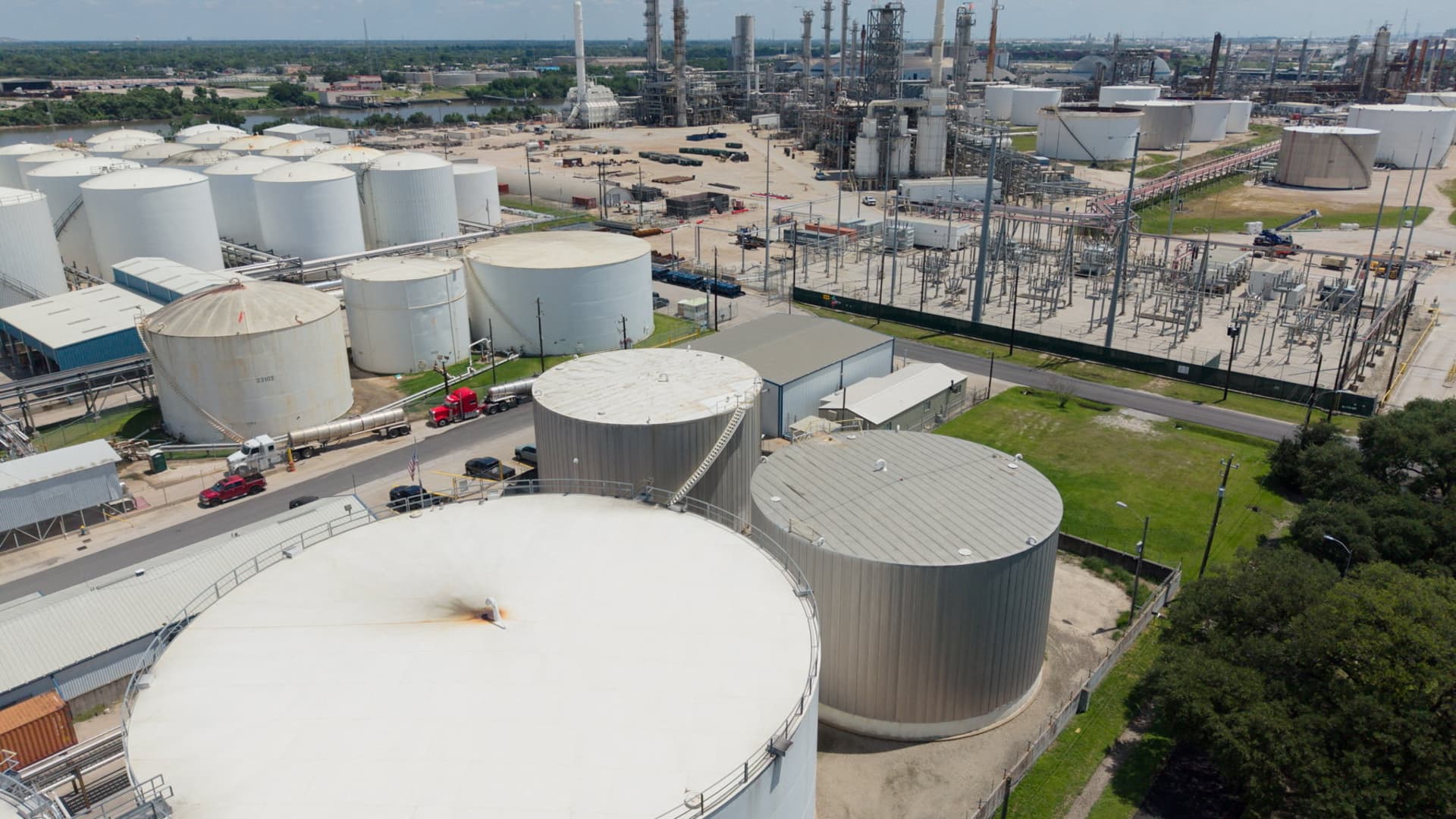
WTI settled Friday near $87.36, the lowest in about six weeks, and ended May down roughly 16 percent for its worst month since 2020 as the reported US-Iran Hormuz reopening framework faded the war premium.
The macro capstone was inflation. April PCE printed at 3.8 percent, the hottest read in nearly three years, all but closing the door on a near-term rate cut and leaving traders pricing essentially zero Federal Reserve cuts for 2026, a backdrop that now sits in the lap of new Fed Chair Kevin Warsh per News.Bitcoin.com. The paradox of the week is that equities ran to records into a hawkish-leaning inflation print, a sign the AI earnings engine is, for now, outweighing the rate path in driving the tape. For the full week's single-name stories, see Saturday's news roundup.
- WTI Fri close ~$87.36, six-week low; -16% in May, worst month since 2020
- Gold Fri close ~$4,509; rebounded from a $4,380 two-month low but lower on the week
- US-Iran Hormuz MOU faded the war premium; Trump had not signed and Iran said it was not final
- April PCE 3.8% cemented the Fed hold; traders price zero 2026 cuts
- Equities ran to records into a hawkish print, AI earnings outweighing the rate path
Week Ahead: Jobs Week, Scenarios Into June
The week of June 1 to June 5 is built around the labor market. ISM Manufacturing PMI opens the week Monday June 1, JOLTS job openings land Tuesday, and ADP private payrolls and ISM Services PMI arrive Wednesday June 3. The marquee event is the May employment report on Friday June 5, the first read on whether hiring held up after a +115,000 April print, and the single most important release for a market trying to gauge how the Warsh-led Fed will react to a 3.8 percent inflation backdrop. A firm jobs number reinforces the no-cuts-in-2026 pricing; a soft number reopens the easing debate that the PCE print had shut down.
Scenarios for next week: a cool jobs report against the AI-earnings tailwind is the melt-up continuation that keeps the S&P probing record territory above 7,580. A hot jobs report layered on the hawkish PCE read is the rotation risk that pressures the highest-multiple AI names and tests the prior shelf. For crypto, the question is whether spot ETF outflows stabilize. A slowdown in redemptions is the bullish trigger for Bitcoin to reclaim the $75,000 zone, continued bleed is the bearish trigger toward the lower end of the six-week range, and the late-May lows mark the invalidation zone traders are watching. Reference levels into Monday: S&P 7,580.06 Friday close, Nasdaq 26,972.62 Friday close, gold $4,509, WTI $87.36, with Bitcoin around $73,950 and Ethereum near $2,025 live.
- Mon Jun 1 -- ISM Manufacturing PMI: first read on factory activity for May. IMPACT: MEDIUM.
- Tue Jun 2 -- JOLTS job openings: labor-demand gauge ahead of payrolls. IMPACT: MEDIUM.
- Wed Jun 3 -- ADP payrolls + ISM Services PMI: private-hiring and services-sector reads. IMPACT: MEDIUM.
- Fri Jun 5 -- May Employment Situation: the macro decider for the Fed path. IMPACT: EXTREME.
- Crypto watch: whether spot ETF outflows stabilize or extend the $2B bleed. IMPACT: HIGH.
For positioning across equities, crypto, oil and gold into next week's jobs report, Bybit's TradFi platform offers tight spreads on BTC, ETH, SPY and WTI exposures with defined-risk tooling. See Saturday's full news roundup for the week's biggest single-name stories and Friday's morning analysis for the record-day structural picture. Not financial advice. Always do your own research.