Nvidia Smashed The Print But The Bar Was Higher
The single biggest catalyst of the second quarter landed Wednesday after the close, and the headline read clean: Nvidia delivered fiscal Q1 2027 revenue of $81.6 billion versus $79.18 billion consensus, with non-GAAP EPS of $1.87 against $1.77 expected. Per the SEC 8-K filing, data center revenue hit a record $75.2 billion, up 92 percent year-over-year, and GAAP gross margin printed 74.9 percent, comfortably ahead of the Street model. The forward guide that we flagged as the line that matters most in yesterday's preview came in at $89.1 to $92.8 billion for Q2, versus the $87.3 billion Wall Street had penciled. The capital-return package was the surprise on top: an incremental $80 billion share buyback authorization and a 25-fold dividend hike from $0.01 to $0.25 quarterly. Yet per CNBC's after-hours coverage, NVDA initially fell more than 2 percent in after-hours trade, with the muted reaction reflecting how much of the beat was already in the $5.3 trillion market cap. Hyperscaler revenue at $38 billion now represents more than half of all data center demand, and CEO Jensen Huang framed the quarter as "demand going parabolic" on the call.
- Revenue $81.6B vs $79.2B est (+85% YoY); EPS $1.87 vs $1.77
- Data center $75.2B (+92% YoY); hyperscalers now >50% of segment
- Q2 guide $89.1-92.8B vs $87.3B Street; gross margin 74.9% GAAP
- Surprise capital return: $80B buyback authorization + dividend 25x to $0.25
- Stock -2% after-hours: clean beat-and-raise but the bar was sky-high
April FOMC Minutes: Four Dissents, The Most Since 1992
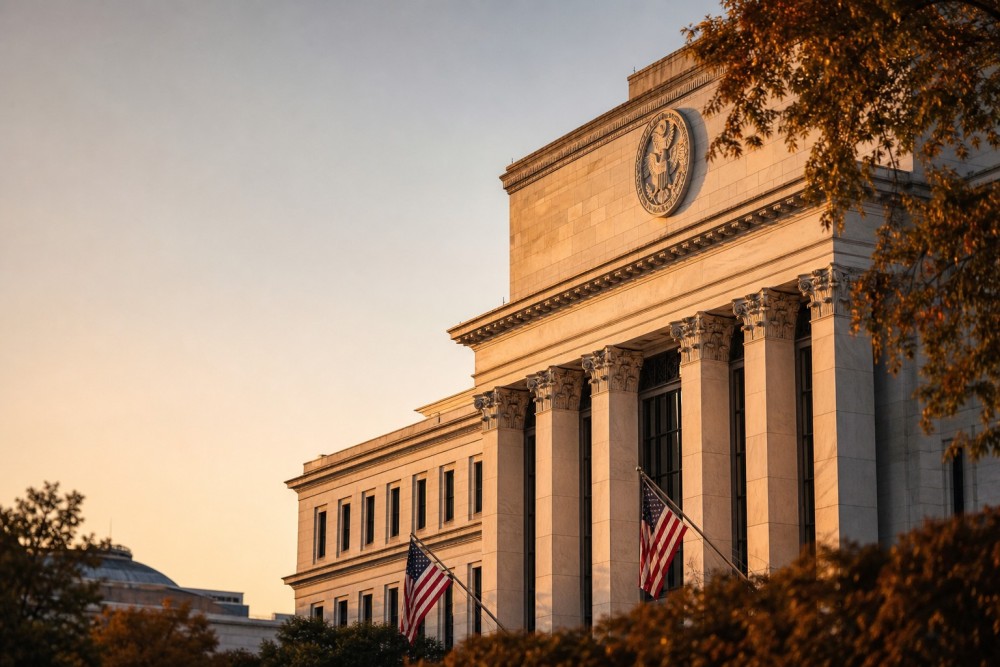
The 2:00 PM ET release of the April FOMC minutes told the second-most-important story of the day, and the structural read was hawkish. Per heygotrade's dissent map, Powell's final meeting recorded four official dissents, the highest count since October 1992, split asymmetrically across the committee. One vote, Governor Stephen Miran, dissented in favor of an immediate rate cut; the other three rejected the policy statement's continued easing bias language, effectively asking the Fed to drop the conditional "may cut" framing. Per Kitco's wrap, the minutes confirm that new Chair Kevin Warsh inherits a fractured committee, with markets now pricing less than 3 percent odds of a cut by year-end and several desks modeling a hike by September. CME FedWatch shows the December hike probability above 50 percent and January at 58 percent. Warsh's known profile is hawkish on balance-sheet runoff but flexible on rates, favoring trimmed-mean inflation measures that can read either way on a given month. The April CPI plus PPI pair we decoded in Thursday's PPI breakdown stays the dominant input until the May data lands.
- Four dissents at the April meeting, the highest count since October 1992
- Miran wanted a cut; three officials wanted the easing-bias language dropped
- CME FedWatch: December hike >50%, January 58%; 2026 cut window effectively shut
- Warsh known profile: hawkish on balance sheet, flexible on rates
- April CPI 3.8% YoY, PPI 6.0% YoY remain the binding inputs into the June meeting
S&P Closed 7,433 Record Pre-Nvidia, ES Futures Sag On The Reaction
Wednesday's cash session was a green-across-the-board run into the Nvidia print. Per The Motley Fool's session wrap, the S&P 500 closed at 7,432.97, up 1.08 percent and at a new record, with the Dow advancing 645.47 points or 1.31 percent to 50,009.35 and the Nasdaq Composite up 1.54 percent to 26,270.36. The pre-print bid reflected the higher-bar consensus we tracked through the week, and the index has now reclaimed the three-day pullback that took it from 7,420 to 7,352 between May 14 and May 19. The after-hours Nvidia reaction has pulled ES June futures back into the red overnight, with the contract trading just below the 7,433 cash close as Asia digested the muted NVDA tape. The bullish trigger above remains 7,500 on a sustained basis; the bearish trigger sits at 7,350, the May 19 base where the pre-Nvidia bid took hold. Near-term invalidation below 7,300 would require a clean Nvidia-driven derating of the AI complex that the actual numbers do not yet justify.
- S&P 7,432.97 record close (+1.08%); Dow 50,009.35 (+1.31%); Nasdaq 26,270.36 (+1.54%)
- The cash session reclaimed the May 14-19 three-day pullback in one print
- ES futures back in the red overnight on the muted Nvidia after-hours tape
- Bullish trigger 7,500; bearish trigger 7,350; invalidation below 7,300
- Today's macro: weekly jobless claims and April existing home sales at 10:00am ET
WTI Sub-$100 As The Iran De-Escalation Sticks
Crude completed the biggest single-session move of the week on Wednesday and the read was structural. WTI front-month settled at $98.26, down 5.66 percent, the first sub-$100 close in three weeks and well below the $108 area touched during the peak of the Strait of Hormuz crisis. Brent fell in parallel, off 5.63 percent to $105.02. The catalyst was the same one we covered in yesterday's morning analysis: Trump's call-off of the planned Iran strike on Monday night, plus a Tuesday statement from Tehran indicating receptiveness to Qatar-mediated talks. The structural read for energy: the geopolitical premium that built between May 9 and May 16 is deflating from the top down, but the strait is not yet officially reopened and the IEA and EIA still model disrupted flows into June. The new key reference zone is $95 to $100 a barrel: a sustained hold above $95 keeps the rate-of-decline question open; a break below $95 would mark the full unwind of the Hormuz premium and put pressure on energy-sector breadth that has driven a large part of the YTD S&P leadership. Brent's parallel move and the absence of a meaningful gasoline crack response both argue the supply side is, for now, more priced than the demand side.
- WTI $98.26 (-5.66%), first sub-$100 close in three weeks; Brent $105.02 (-5.63%)
- De-escalation premium deflating top-down from the $108 Hormuz peak
- Strait not yet officially reopened; IEA and EIA still model disrupted flows into June
- Key reference zone $95-$100; break below $95 = full Hormuz premium unwind
- Watch energy sector breadth for the second-order S&P leadership impact
BTC Holds $77K, ETH Down 10% On The Week
The crypto tape went into Wednesday's print as a rates proxy and came out of it the same way. Bitcoin trades at $77,564 on TradingView, up 0.80 percent on the 24-hour window and recovering modestly from the $77,063 May 19 low. It remains beneath its 200-day moving average for the eighth consecutive session, the longest stretch under that reference since the autumn 2024 base. Ethereum sits at $2,132, up 0.84 percent on the day but still down roughly 10 percent on the week, with more than $700 million in long-position liquidations through the May 13 to May 18 window per derivatives-tracker data. The Trump Media decision to withdraw its spot Bitcoin ETF filing yesterday added a small drag on sentiment but had no measurable price impact, the asset is too large for any single ETF sponsor headline to move it materially. The reference structure is unchanged from Tuesday's analysis: $76,000 remains the post-NFP cycle base and next visible support, while a clean reclaim of $80,000 would be the first signal the post-PPI bearish break has failed. Gold sits at $4,515, off 0.55 percent on the session and within the $4,441 to $4,717 weekly range as the firmer dollar and yield structure continue to weigh.
- BTC $77,564 (+0.80%); 8th day below 200-day MA, longest stretch since autumn 2024
- ETH $2,132 (+0.84%) but -10% on the week; $700M+ in long liquidations May 13-18
- Trump Media withdrew its spot BTC ETF filing; no measurable price impact
- Reference structure: $76K next support; $80K reclaim invalidates the bearish break
- Gold $4,515 (-0.55%); pressured by dollar and real-yield structure
Bottom Line
Thursday is the post-print digestion day, and the structural read is two parallel forces pulling in opposite directions. Nvidia delivered a clean beat-and-raise that validates the AI-capex thesis through year-end: $81.6 billion on the print, an $89-$92.8 billion Q2 guide, $75.2 billion in data center revenue, and a surprise $80 billion buyback authorization plus a 25-fold dividend hike. The muted after-hours tape on a 2 percent decline reflects how much was already priced into the $5.3 trillion market cap, not a problem with the numbers themselves. Against that, the April FOMC minutes confirm a hawkish Fed inheritance for Warsh with four dissents the most since 1992, December hike odds above 50 percent on CME FedWatch, and the 2026 cut window effectively shut. The S&P 500 cash closed at a 7,432.97 record on the pre-Nvidia rally but ES futures sit modestly red overnight; the cleanest reference structure is the 7,500 bullish trigger above and the 7,350 bearish trigger below. WTI sub-$100 at $98.26 is a structural Iran-easing signal and a second-order risk to S&P energy-sector breadth. BTC $77,564, ETH $2,132 and gold $4,515 are all consolidating beneath their inflection levels. Today's domestic macro: weekly jobless claims and April existing home sales at 10:00am ET.
For traders following the post-Nvidia AI-capex tape and the rates-versus-earnings narrative, Bybit's TradFi platform offers tight spreads on US equity, FX and commodity exposures with defined-risk tooling. Not financial advice. Always do your own research.