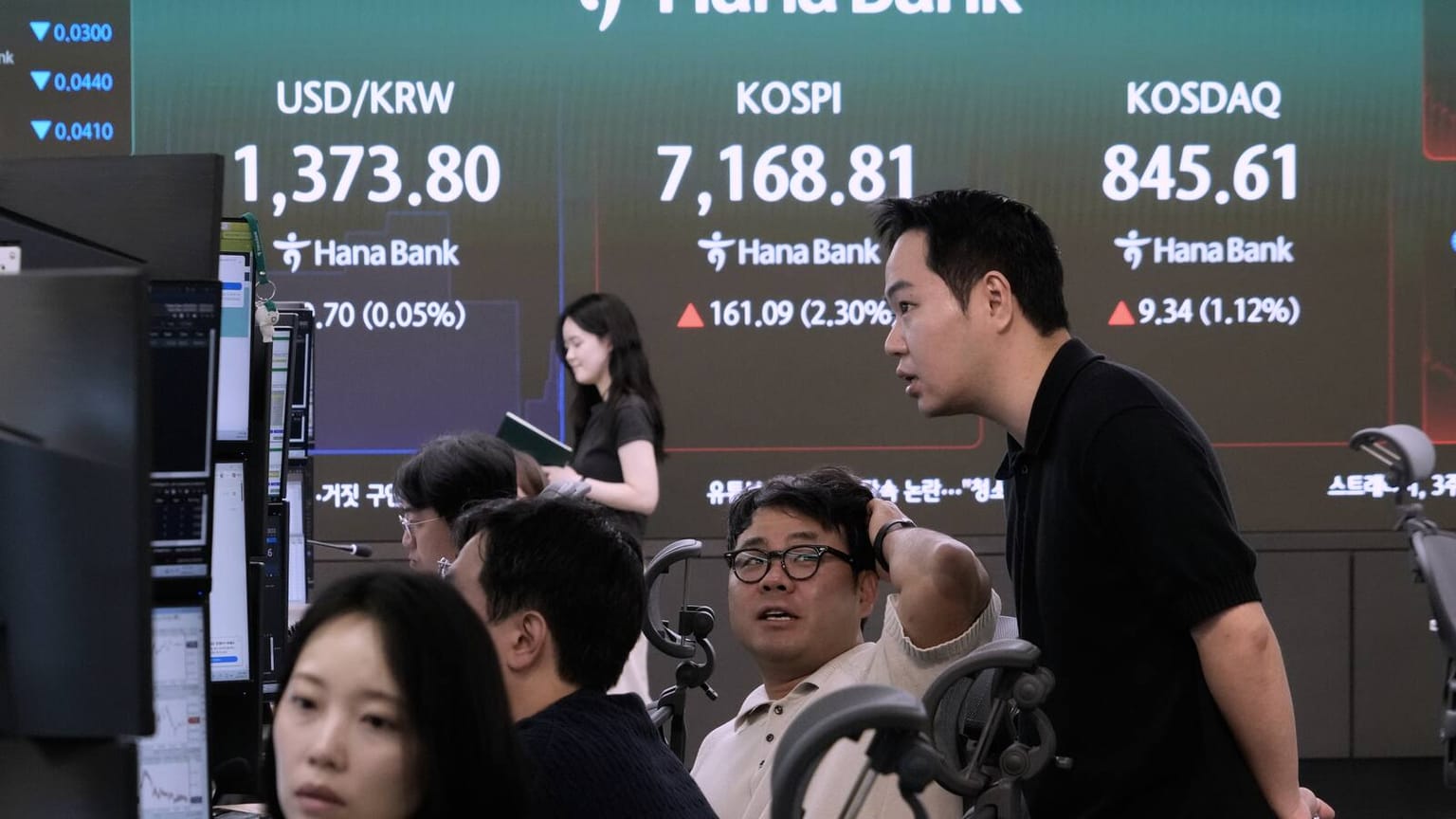
The week's risk-off tone hardened overnight as a global rout in technology and semiconductor stocks picked up speed. The selling started in Asia, where South Korea's chip-heavy KOSPI fell close to double digits, and rolled straight into Wall Street: the Nasdaq Composite sank 2.21 percent to 25,587.04 and the S&P 500 dropped 1.44 percent to 7,365.46 on June 23, with the damage concentrated in the AI infrastructure trade that has powered the market for the past year. ES overnight futures point lower again into Wednesday, and the relief impulse from the Iran peace roadmap has given way to a colder question: whether the enormous capital pouring into AI will earn its keep. Here is the picture as the session opens.
The Overnight: A Chip Rout Goes Global
This was a breadth event masquerading as an index move. The VanEck Semiconductor ETF slid about 7 percent, its worst session in months, as the entire chip complex repriced at once. The selling was not confined to the United States: it began before the US open, with the KOSPI's near double-digit drop signalling that the unwind was global rather than a single-name story. As TheStreet reports, a Bank of America rate-hike note added a macro accelerant, reviving the higher-for-longer rate fear that bites hardest in the longest-duration corner of the market. The combination of a global chip unwind and a fresh hawkish rate signal is exactly the mix that turns a wobble into a rout.
- Nasdaq down 2.21% to 25,587.04; S&P 500 down 1.44% to 7,365.46
- The VanEck Semiconductor ETF fell about 7%, a global repricing of chips
- Selling started in Asia, with Korea's KOSPI near a double-digit drop
- A Bank of America rate-hike note added a hawkish macro accelerant
- ES overnight futures point lower into the Wednesday cash open
Story of the Day: Semiconductors Lead the Retreat
The defining move was in the chips themselves. Micron sank roughly 11.4 percent, unwinding a large part of its recent AI-memory rally, while Taiwan Semiconductor fell about 5.2 percent and the rest of the sector followed. The trigger was not a single earnings miss but a shift in narrative: investors grew increasingly concerned that the massive AI infrastructure spending by hyperscalers may generate weaker-than-expected returns. For more than a year the market has paid up for anything tied to building out AI compute, on the assumption that the demand would be all but unlimited. The moment that assumption is questioned, the most richly valued names in the most crowded trade are where the air comes out fastest, and that is precisely where it came out. This echoes the Alphabet brain-drain selloff earlier in the week: each fresh crack in the AI bull case is now met with an outsized reaction.
- Micron fell about 11.4%, reversing much of its AI-memory rally
- Taiwan Semiconductor slid about 5.2% as the sector followed lower
- The catalyst was doubt over AI infrastructure returns, not one earnings print
- The most richly valued, crowded names took the hardest hit
- Each new crack in the AI bull case now draws an outsized response
The Rate Backdrop Tightens the Screw
Underneath the chip story sits a less dramatic but more durable pressure: the cost of money. The US 10-year Treasury yield is sitting near 4.48 percent, and the Bank of America note that helped spark the selling leaned into the case that rates could stay higher for longer, or even rise. As Yahoo Finance notes, traders are now bracing for the PCE inflation report, the Federal Reserve's preferred gauge, alongside a busy week of spending and factory-order data. A higher discount rate mechanically lowers the present value of the distant cash flows that justify mega-cap tech valuations, so a firm PCE print would compound the equity-market pressure rather than relieve it. Not every corner suffered, though: 24/7 Wall St notes real estate, energy and healthcare actually finished higher as money rotated out of growth and into value.
- The 10-year Treasury yield sits near 4.48%, keeping pressure on growth
- A Bank of America note revived the higher-for-longer rate fear
- This week's PCE inflation report is the key macro catalyst
- A firm PCE print would compound the pressure on long-duration stocks
- Real estate, energy and healthcare rose on a rotation into value

Crypto: Bitcoin Holds, Ethereum Lags
Digital assets caught the same risk-off draft, but with less violence than equities. Bitcoin held roughly flat near $62,700 over the past 24 hours, though it is down about 5.5 percent on the week as the broad de-risking weighs. Ethereum lagged, easing about 3.9 percent toward $1,670, giving back its recent outperformance as the rotation out of risk hit the higher-beta major harder. With the equity tape leading and macro firmly in the driver's seat, crypto is trading as a risk asset rather than a haven this week, taking its cue from yields and the tech unwind rather than any crypto-specific catalyst. The structure to watch: Bitcoin's low-$63,000s remain the near-term pivot, where buyers have repeatedly stepped in, while a sustained break below the $62,000 area would weaken the structure. Ethereum's reference zone sits around $1,650, the level that has cushioned recent dips.
- Bitcoin roughly flat near $62,700 on the day, down about 5.5% on the week
- Ethereum eased about 3.9% toward $1,670, lagging the majors
- Crypto is trading as a risk asset, tracking yields and the tech unwind
- Bullish pivot: the low-$63,000s; below $62,000 weakens the structure
- Ethereum's $1,650 reference zone has cushioned recent dips
Gold and Oil Both Ease
The commodity complex offered no shelter either. Spot gold slipped toward $4,086, extending its pullback from recent highs as the fading geopolitical risk premium, following the US-Iran peace progress, continues to trim safe-haven demand. With the war premium draining and real yields holding firm near a 4.48 percent 10-year, the opportunity cost of holding a non-yielding metal stays elevated. Crude told the same story from the supply side: WTI fell near $73 at a roughly three-month low, extending losses as signs of progress in US-Iran peace talks ease the threat of disruption. As the FXDailyReport analysis lays out, the path of least resistance has turned lower while the diplomatic track holds. The structure: $73 is the near-term reference for crude, with a bearish trigger on a sustained break below it and a bullish trigger if the talks stall and rebuild the risk premium.
- Gold slipped toward $4,086 as the safe-haven premium fades
- Firm real yields near a 4.48% 10-year keep pressure on bullion
- WTI fell near $73, a roughly three-month low
- US-Iran peace progress keeps the oil path lower for now
- Crude reference: $73; a stall in talks would rebuild the risk premium
What to Watch Today
The session hinges on whether the chip rout finds a floor or feeds on itself. The immediate question is if dip buyers step into semiconductors after a 7 percent sector drop, or whether the AI-returns doubt keeps the unwind going for a second day. The macro calendar is the wild card: any hot reading in the run-up to PCE would harden the higher-for-longer narrative and press long-duration stocks further, while a soft print could spark a relief bounce in exactly the names that have been hit hardest. In crypto, the test is whether Bitcoin can keep holding its low-$63,000s while equities wobble, or whether the risk-off move drags it through support. Bullish trigger for risk: chips stabilising, yields easing and a benign data run into PCE. Bearish trigger: another leg down in semis or a fresh yield surge that extends the tech unwind.
- Will dip buyers step into semiconductors or does the unwind extend
- The run-up to PCE is the key macro swing factor this week
- Watch whether Bitcoin holds its low-$63,000s as equities wobble
- Bullish trigger: chips stabilise, yields ease, benign data into PCE
- Bearish trigger: another leg down in semis or a fresh yield surge
ThriveInMarkets publishes market commentary for general information only and does not provide personal investment advice. Prices are live or last-close levels as labeled and move quickly; levels cited are technical reference points, not instructions to buy or sell any asset.