The Setup: Where Tariffs Sit Going In
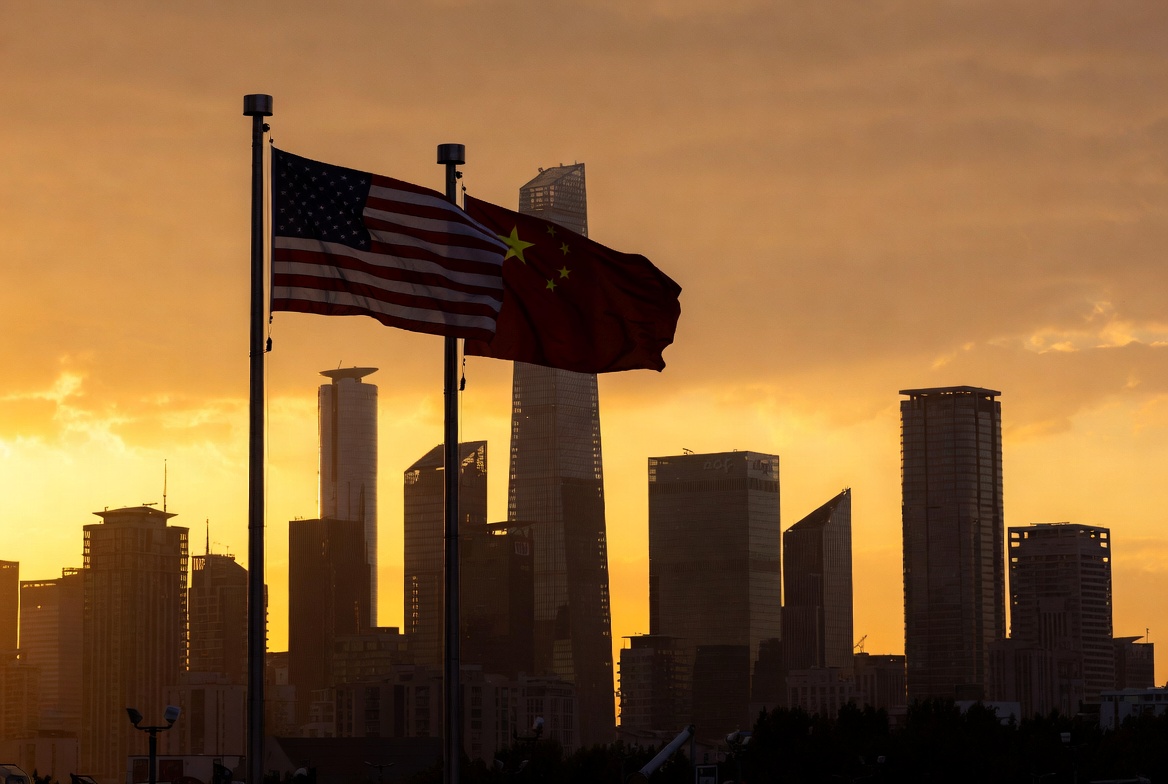
President Trump arrives in Beijing on Thursday May 14, 2026 for a two-day summit with President Xi Jinping that runs through Friday May 15. It is the first visit to China by a US president since November 2017, and it lands in the middle of the most consequential macro week of the spring: April CPI prints Tuesday, the Senate Banking Committee marks up the CLARITY Act Thursday, and the leaders of the world's two largest economies sit down for the first time on Chinese soil in nearly a decade.
Going in, the trade ceasefire from the October 2025 Busan meeting is intact but fragile. That summit trimmed US tariffs on Chinese imports from 57% to 47% and locked in a one-year truce with corresponding Chinese reductions and commitments around fentanyl interdiction and US soybean purchases. The 47% rate is the working floor traders have been pricing for the past seven months. The summit asks one question only: does that floor move down, sideways, or up.
- Summit dates: Thursday-Friday, May 14-15 2026, in Beijing. First US presidential trip to China since November 2017.
- Tariff floor: 47% US on Chinese imports, post-Busan (October 2025), down from 57% peak.
- One-year truce from Busan governs the current ceasefire; expires late 2026 absent renewal.
- Lands inside the heaviest macro week of the spring (April CPI Tue, CLARITY Act markup Thu).
The Iran Wildcard
The market consensus going in -- captured cleanly by the CNBC read on May 8 and the Atlantic Council's pre-summit brief -- is that the Iran war coordination is going to eat the agenda. The Friday May 8 US-Iran fire exchange that briefly lifted WTI on the Hormuz cease-fire wobble is exactly the kind of event that pulls a trade summit into a security summit. China is Iran's largest oil customer, holds the only meaningful diplomatic channel into Tehran outside the Gulf framework, and has every reason to negotiate price-of-cooperation rather than trade-deliverable.
If Iran dominates, the trade chapter gets scaled back to communiques and working-group commitments, and the 47% tariff structure becomes the explicit status quo rather than a transitional rate. That is not a tail risk: Fortune's Sunday read notes Beijing is reportedly working backward from the US 2026 midterms and has limited incentive to hand Trump a clean trade win five months before November.
What's Actually On The Table
Three deliverables are realistic -- and each has a clean market read.
1. Rare earths. The US is pushing for sustained access to critical minerals as China's export-license framework continues to throttle non-friendly buyers. A formal commitment unlocks the second leg of the domestic critical-minerals capex cycle: MP Materials, USA Rare Earth, and the broader REMX complex. A null result keeps the bottleneck and supports the strategic-stockpile narrative.
2. Boeing and aerospace. Industry chatter centers on a potential order of up to 500 Boeing aircraft spread over multiple years, the kind of headline number that historically gets paraded at presidential summits. A clean number lifts BA, the aerospace supply chain, and the broader industrials cohort. A vague communique with no order book is read as a deferral.
3. Agriculture. Sustained Chinese imports of US soybeans and other ag staples are the clean win the administration can sell domestically. Look for a stated annual purchase commitment with a multi-year envelope; ADM, Bunge, and the broader DBA complex respond directly to that number.
- Rare earths: formal access framework -> bullish MP, USAR, REMX. Null -> bullish strategic-stockpile narrative.
- Boeing aircraft order: 500-unit headline -> bullish BA, aerospace supply chain, industrials.
- Soybean / ag purchase commitment: stated annual + multi-year envelope -> bullish ADM, BG, DBA.
- AI export controls: any softening on advanced-chip restrictions -> bullish NVDA, AMD; tightening -> bearish semis.
The H2 Tariff Watch That Doesn't Go Away
Independent of the summit outcome, the structural read is that the Atlantic Council frames as a "fragile relationship defined more by an absence of friction than any affirmative agenda". The US administration has signaled fresh import duties prepared for the back half of 2026, and Beijing has stated it will respond in kind. That means the semis cohort -- which has carried a 7% weekly run on the AMD beat and is now pricing into Nvidia's Q1 FY27 print on May 20 -- has an unresolved tariff hanging over it for H2.
If the Beijing summit produces a meaningful AI export-control framework, that overhang lifts. If the summit ends with communiques and Iran-coordination language, the overhang stays. Position accordingly.
Market Read: How To Trade The Setup Window

Three scenarios into the summit window: a clean trade deliverable (upside), an Iran-dominated communique with the 47% floor unchanged (base case), or AI export tightening with no deliverables (downside). Position the semis, aerospace, ag and rare-earth cohorts accordingly.
This is a binary headline event compressed into 36 hours. The asymmetry is real.
Upside scenario (clean trade deliverables): rare earths framework + Boeing number + AI export softening. Read-through: bullish semis, aerospace, ag, USD-light-bullish, gold-relief. Risk-on extension into next week's CPI tail.
Base case (Iran dominates, communique trade): 47% tariff status quo, soft ag commitment, rare-earth working group. Read-through: neutral-to-mild-tightening for risk, gold supported, USD range, semis hold the AMD-led tape but lose some H2 narrative.
Downside scenario (no deliverables, AI export tightening): NVDA/AMD direct headwind, industrials soft, USD bid, gold bid, China-A and HSI direct hit. Risk-off into the CPI / CLARITY Act tape.
- Tariff floor is 47% -- watch whether the summit moves it.
- Iran focus = base case per CNBC + Atlantic Council; trade deliverables get deferred.
- Sectors with direct read: rare earths (MP, USAR), aerospace (BA), ag (ADM, BG, DBA), semis (NVDA, AMD), and the broader China-A / HSI complex.
- Headline window: Thursday May 14 cash open through Friday May 15 close.
- Don't fight the macro week: CPI Tuesday and the CLARITY Act markup Thursday are competing for tape; size accordingly.
For positioning across semis, aerospace and the broader risk complex into the summit window, Bybit's TradFi platform offers tight spreads on US equity and FX exposures with defined-risk tooling. See Sunday's full weekend recap for the macro week framing and Saturday's news roundup for the week's biggest single-name stories. Not financial advice. Always do your own research.