The week in markets: April 19 to April 25, 2026. Two narratives carried the tape. The first was an AI semiconductor re-rate that lifted Nvidia back above $5 trillion in market cap and pushed Intel to its biggest single-day move since 1987 on a Q1 print that broke Wall Street consensus across every line. The second was a crypto cross-chain unlock: wrapped XRP went live on Solana via LayerZero and Hex Trust, US spot Bitcoin ETFs absorbed $2.1 billion over an eight-day inflow streak, and Shiba Inu cleared a one-trillion-token exchange-flow threshold for the first time. Underneath both threads, the Iran tanker tape kept WTI bid above $90 all week and the FOMC on April 28-29 sits four trading days out as the dominant macro event. Below is the full week-in-markets read.
Top Stock Stories of the Week
1. Nvidia retakes $5 trillion market cap as AI chip trade reaccelerates
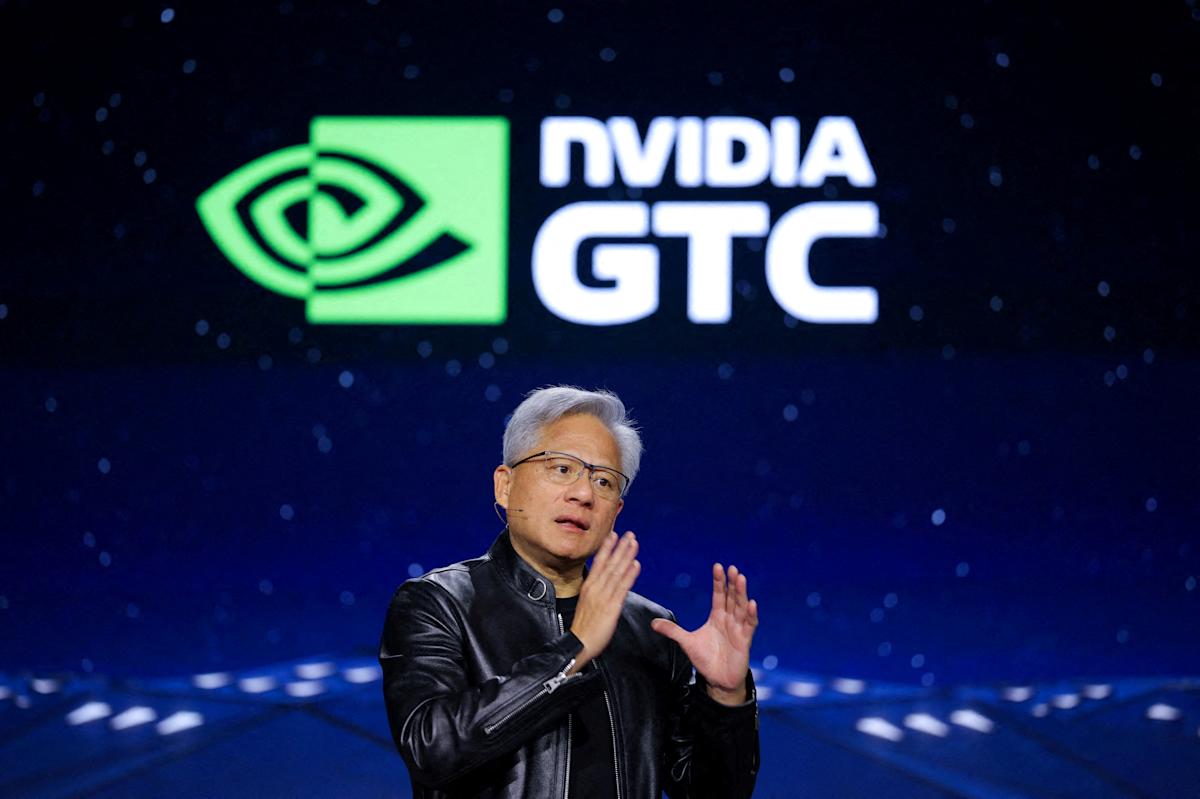
Nvidia closed Friday at $208.27, up 4.3% on the day, pushing the company's market capitalization past $5 trillion intraday and as high as $5.12 trillion. It was the first record close for the stock since October 2025, when NVDA first crossed the $5T threshold before pulling back into the late-2025 chip rotation. Nvidia is now worth roughly $1 trillion more than the second-largest US-listed company, Alphabet, and is up more than 14-fold since the end of 2022. Friday's catalyst was Intel's Q1 print landing late Thursday: the strong DCAI and foundry numbers re-validated AI infrastructure demand into the May earnings cycle for Microsoft, Amazon, Meta, and Alphabet, and the entire chip complex repriced. AMD added 12% on the week, ARM, MRVL, SMCI, ASML, and TSM all closed up 3.5% or more.
The structural read is what matters into next week. Hyperscaler capex prints land starting Tuesday and Wednesday. If Microsoft, Amazon, and Meta confirm 2026 capex guides at or above current consensus (roughly $300B aggregated for the four largest spenders), the implication for Nvidia data-center revenue runs through the next two quarters and the $5T cap holds structurally. If any one of them eases the capex line, the AI semis trade gets re-tested and NVDA has air down to $190 first.
- NVDA $208.27 (+4.3%), market cap $5.12T intraday — first $5T close since October
- $1 trillion gap to Alphabet — single biggest US listed company, AI infrastructure trade reaccelerating
- Chip complex breadth: AMD +12% week, ARM, MRVL, SMCI, ASML, TSM all +3.5% or more
- Hyperscaler capex prints next week are the validation event for the $5T re-rate
2. Intel rips 24% on biggest single-day move since 1987
Intel's Q1 2026 print on Wednesday April 23 was the standout earnings event of the week. Revenue of $13.6 billion came in roughly $1.4 billion above consensus, and non-GAAP EPS of $0.29 obliterated the $0.01 consensus number for a 2,800% surprise. The two segments that mattered: Data Center and AI grew 22% year-over-year to $5.1 billion, and Foundry revenue climbed 16% to $5.4 billion as CEO Lip-Bu Tan confirmed Intel 18A entered high-volume manufacturing during the quarter with RibbonFist and backside power delivery. AI-related revenue is now 60% of the total business and growing 40% year-over-year. The stock closed Thursday with its largest single-day gain since 1987 (24%) and finished the week with year-to-date returns near 100%.
The implication for the broader chip tape was immediate. Intel's quarter validated the read that the AI infrastructure cycle is not a Nvidia-only story, and that foundry demand is broadening as Western customers diversify away from a single Asian supply chain. That is what dragged the rest of the chip complex higher into Friday and what put Nvidia back through $5T.
- INTC Q1 revenue $13.6B vs $12.32B consensus, EPS $0.29 vs $0.01 — 2,800% surprise
- DCAI +22% YoY to $5.1B, Foundry +16% to $5.4B — AI is 60% of revenue and growing 40%
- Intel 18A in high-volume manufacturing — Western foundry capacity is no longer hypothetical
- Single-day +24% (largest since 1987), stock now +100% year-to-date
3. Tesla beats Q1 EPS but guides 2026 capex to $25B and triggers a -3.6% Friday flush
Tesla's Wednesday post-close print was the week's most controversial earnings event. The headline numbers were constructive: Q1 revenue of $22.4 billion was up 16% year-over-year, EPS of $0.41 beat the $0.38 consensus, and deliveries grew 6.3% to 358,023 vehicles. The robotaxi service expanded to Dallas and Houston and is now operating without in-car safety monitors. The problem was the capex line. Tesla lifted 2026 capital expenditure guidance from $20 billion to over $25 billion, including a $3 billion research chip fab in Texas to be shared with SpaceX and xAI. Musk explicitly framed 2026 as a multi-year investment cycle with negative free cash flow for the rest of the year. Adjusted accounting underneath the headline was the bigger problem: of $491 million in GAAP profit, only $21 million came from core vehicle and battery operations. The remainder was carbon credits ($297M) and Bitcoin gains ($173M).
The tape response was a 4% post-close pop on the EPS beat that fully reversed by Thursday's cash close. TSLA finished Thursday at $373.60, down 3.59% on the day and 17% year-to-date. The reference band for the stock now sits at $360 (prior shelf), $380-$390 (former consolidation lid), and the 200-day moving average near $340. For context on how the print landed against the pre-earnings consensus band, see Wednesday's morning analysis.
- TSLA Q1 revenue $22.4B (+16% YoY), EPS $0.41 beat $0.38, deliveries 358,023
- 2026 capex guided to $25B+ (up from $20B) — negative FCF for the rest of the year baked in
- $21M of $491M GAAP profit from core auto, rest from credits ($297M) + BTC ($173M)
- Robotaxi expanded to Dallas and Houston with no safety monitors — execution proof point
- Stock -3.6% Thursday, -17% YTD; reference zones $360 / $380-390 / $340 (200-day)
4. Mega-cap tech sets up for next week's earnings gauntlet
Over 100 major companies reported Q1 2026 results during the week, but the next ten days carry the heaviest concentration of mega-cap prints of the year. Microsoft, Amazon, Meta, and Alphabet all report between Tuesday April 28 and Thursday April 30, alongside Nvidia's earnings cadence later in May. The setup heading into the prints is constructive: the S&P 500 sits at 7,108 (within 18 points of the April 18 all-time high of 7,126), AI infrastructure breadth is broad, and the Intel print already validated the demand side of the trade. The risk is concentration. The four hyperscalers plus Nvidia represent more than 35% of the S&P 500's market cap, and any single capex disappointment compresses the entire index. The reference structural floor remains 7,060 (Tuesday's shelf) and 7,000 (round number that held on April 14 and 17).
- 100+ companies reported this week; mega-cap concentration prints next Tuesday-Thursday
- MSFT, AMZN, META, GOOGL all next week — capex guides validate or break the AI re-rate
- SPX 7,108 sits 18 points below the April 18 ATH; floor at 7,060 then 7,000
- 4 hyperscalers + NVDA = 35% of SPX cap — any single guide miss compresses the index
5. Energy sector leadership: WTI holds $94 as Iran tanker tape stays the lead macro driver
Oil was the quietest standout of the week. WTI crude printed $94.10 by Friday, a fourth straight session of gains and roughly 18% above where it traded the prior Friday. Brent holds near $96. The driver chain is unchanged from the morning analysis posts: US Central Command's running tanker-redirect count is 31 vessels, the blockade now operates in open water (three Iranian tankers were intercepted off Malaysia, India, and Sri Lanka on April 23), and Iran has not formally accepted the Trump ceasefire extension. XLE (energy sector ETF) closed the week at year-highs as Exxon, Chevron, and ConocoPhillips all benefited. Airlines and consumer discretionary lagged on the fuel-cost pass-through. For the operational chain that drove the price action all week see Friday's morning note and Tuesday's pre-extension setup.
- WTI $94.10, Brent ~$96 — fourth straight session up, +18% on the week
- CENTCOM running count 31 tankers redirected; blockade operates in open water now
- XLE at year-highs; airlines, consumer discretionary lag on fuel pass-through
- Reference band: $96 above opens $100; floor at $88 then $85 (Energy Dept normalized)
Top Crypto Stories of the Week
1. Wrapped XRP goes live on Solana via LayerZero and Hex Trust
The biggest cross-chain crypto story of the week was confirmed Friday April 17: wrapped XRP (wXRP) launched on Solana through cross-chain protocol LayerZero with custodian Hex Trust. Each wXRP is backed 1:1 by native XRP held in segregated custody and is redeemable at any time. The token is already trading on Phantom Wallet, Jupiter Exchange, Titan, Meteora, and Byreal, putting XRP liquidity inside Solana's DeFi stack for the first time. Hex Trust disclosed in December 2025 that the broader rollout would also target Ethereum, Optimism, and HyperEVM. XRP responded with a 5.15% pop to $1.50 immediately on the announcement and the price has held the level into Friday's close.
The structural read is more important than the price move. XRP has historically existed in a closed-loop ecosystem on the XRP Ledger, with bridges to other chains being friction-heavy or custodial in unfamiliar ways. wXRP on Solana via LayerZero is the cleanest cross-chain unlock yet — it brings $50B+ of latent XRP market cap into reach of Solana's $400B+ DeFi liquidity stack, and it sets the template for the Ethereum and Optimism rollouts already on the calendar. XRP-spot ETF assets crossed $1 billion the same week.
- wXRP live on Solana via LayerZero + Hex Trust, 1:1 backed and redeemable
- Trading on Phantom, Jupiter, Titan, Meteora, Byreal — full Solana DeFi stack
- XRP +5.15% to $1.50 on launch and holding; XRP-spot ETF assets crossed $1B same week
- Ethereum, Optimism, HyperEVM rollouts next on the Hex Trust roadmap
2. US spot Bitcoin ETFs absorb $2.1B over an 8-day inflow streak
The institutional bid for Bitcoin reasserted itself this week. US spot Bitcoin ETFs logged eight consecutive days of net inflows through April 23, totaling roughly $2.1 billion. Cumulative net inflows since launch crossed $58.55 billion, bringing total assets under management to $102 billion. Last week's total of $996 million was the largest single weekly inflow since mid-January 2026. BlackRock's IBIT carried the bulk of the flow, attracting $214 million in a single session and extending its consecutive-inflow streak to five trading days. The notable second-order signal: short-term holders (defined as wallets holding for less than 155 days) quietly began distributing to ETF buyers during the same eight-day window, which is the textbook handoff that historically precedes the next leg of the cycle.
BTC traded inside a $76K-$80K range all week and currently sits at $77,755 (24-hour change -0.66%). The behavioral structure is constructive: no daily close below $75K all month, ETF flows progressively absorbing dips at shallower discounts, no funding-rate stretch on perps, and no liquidation wick. The next event is the FOMC on April 29.
- $2.1B net inflows over 8 sessions, $58.55B cumulative since launch, $102B total AUM
- Last week's $996M was the largest weekly inflow since mid-January 2026
- BlackRock IBIT $214M single day, 5-session inflow streak
- Short-term holders distributing to ETFs — classic late-cycle handoff signature
- BTC range $76K-$80K into the FOMC; no April daily close below $75K
3. Shiba Inu crosses one trillion SHIB exchange-flow threshold
SHIB cleared a meaningful on-chain marker for the first time this week. Total exchange outflows reached approximately 1.24 trillion SHIB tokens, with inflows around 1.13 trillion, leaving net flow marginally negative but well above any prior weekly window. The pattern is supply removal from exchanges (typical of accumulation behavior) rather than aggressive selling. The price has not yet responded — SHIB remains in its multi-month downtrend — but the on-chain footprint is the first structural shift of large-holder behavior in months. Worth tracking into the next two weeks because exchange-supply removal at this scale has historically preceded SHIB price reflexes by 2-4 weeks.
- 1.24T SHIB outflows vs 1.13T inflows — net negative flow, supply leaving exchanges
- First trillion-token threshold in months for SHIB exchange-flow data
- Price hasn't responded yet — historical lag is 2-4 weeks
- On-chain accumulation signature, not capitulation — large-holder positioning shift
4. Ripple unveils quantum-proofing roadmap for the XRP Ledger
Adjacent to the wXRP-Solana launch, Ripple published a quantum-proofing roadmap for the XRP Ledger this week, targeting full quantum-resistance by 2028. The roadmap covers signature-scheme upgrades, post-quantum cryptography integration, and a phased migration path that does not require a hard fork. The 2028 timeline puts XRP Ledger ahead of Ethereum and Bitcoin on the public chains' quantum-resistance schedule. Practical near-term impact is limited (no quantum threat is operational today), but the announcement is part of a broader institutional-positioning push around XRP that includes the spot ETFs crossing $1 billion in assets and the Solana cross-chain rollout.
- Quantum-proofing roadmap published, full resistance targeted by 2028
- No hard fork required — phased PQC migration path
- Ahead of ETH and BTC on the public-chain quantum-resistance schedule
- Part of broader institutional push: ETFs $1B+, Solana rollout, banking partnerships
5. ETH lags BTC, SOL holds key levels, broader top-50 mixed
Ethereum traded $2,305 into Friday's close, holding the $2,300 shelf that has been defended on every test this month but visibly lagging Bitcoin on relative strength. Spot ETH ETF inflows this week were softer than March averages and BTC dominance climbed further. Solana traded sideways in the $85 area despite the wXRP catalyst, with wXRP launch buying being absorbed by broader profit-taking. Among the rest of the top 50, the standouts were XRP (+5% on the week on the wXRP launch), AVAX (steady on subnet activity), LINK (oracle network usage hitting a record), and INJ (deflationary burn metrics ticking up). DOGE remained range-bound, ADA lagged, and the L2 basket (ARB, OP) mostly underperformed L1 majors.
- ETH $2,305 — $2,300 shelf holds but lagging BTC on relative strength; ETH-ETF flows softer
- SOL ~$85 sideways despite wXRP launch — broader profit-taking absorbed catalyst
- Top 50 standouts: XRP (+5%), LINK (record oracle usage), AVAX (subnet activity), INJ (burn metrics)
- BTC dominance climbing — capital is concentrating in BTC into the FOMC
M&A, Partnerships, Deals
The week produced three notable deal announcements. QXO is acquiring TopBuild for $17 billion in the largest US building-products M&A of 2026, consolidating insulation-installation and air-distribution capacity. Blue Owl is buying Sila Realty for $2.4 billion in a healthcare-real-estate take-private. Roche announced a $595 million acquisition of a Triangle-area diagnostics firm, continuing the post-COVID consolidation in the molecular diagnostics space.
On the partnerships side, the week's biggest cross-industry announcement was Tesla's confirmation of a $3 billion research chip fab in Texas to be shared with SpaceX and xAI as part of the $25B capex guide. The tri-company structure is the first large public confirmation of integrated AI compute infrastructure across Musk's portfolio. Separately, Morgan Stanley launched a $1 Stablecoin Fund, signaling deepening TradFi infrastructure for crypto post-GENIUS Act, and GraniteShares debuted 3x long and short daily ETFs on Nasdaq, expanding institutional trading tools across single-stock leverage.
- QXO + TopBuild $17B — biggest 2026 US building-products consolidation
- Blue Owl + Sila Realty $2.4B — healthcare REIT take-private
- Tesla + SpaceX + xAI shared $3B chip fab in Texas — Musk-portfolio AI compute integration
- Morgan Stanley $1 Stablecoin Fund launched — TradFi crypto infrastructure deepening
Regulatory and Macro
The macro setup for next week is dominated by the FOMC on April 28-29, Powell's last presser as Chair, and the unresolved Warsh confirmation block. The Senate Banking Committee remains tied 12-12 with Senator Tillis holding pending the DOJ Powell investigation being dropped. There is no procedural workaround under Senate rules that bypasses Tillis. CME FedWatch puts the April hold probability at 85%, with the first cut now pushed to the June 17 SEP meeting where new dot-plots land. The trade is the wording, not the rate decision.
On the crypto regulatory front, the GENIUS Act stablecoin framework is on track for full implementation by July 18, 2026, with federal banking agencies finalizing the comprehensive regulatory framework for stablecoin issuers. SEC Division of Trading and Markets issued an April 13 statement on broker-dealer registration carve-outs for cryptoasset interface operators. Federal banking regulators finalized changes to the community bank leverage ratio on April 23. The regulatory backdrop is structurally crypto-friendly into Q3 2026.
The Iran tanker tape is the lead geopolitical macro driver. CENTCOM's open-water blockade now reaches 31 redirected vessels and Iran has not formally accepted Trump's ceasefire extension, keeping a war premium baked into oil and gold. Gold sits at $4,726 with the Fed wording trade as the next reflex.
- FOMC April 28-29 — 85% hold priced, no new dots, wording is the entire trade
- Powell's final presser as Chair with Warsh confirmation still blocked 12-12 in committee
- First cut priced at June 17 SEP meeting — dot-plot updates re-anchor the rate strip
- GENIUS Act stablecoin framework on track for full July 18 2026 implementation
- Iran tanker blockade at 31 redirected vessels keeps war premium baked into oil and gold
Week Ahead: What to Watch
- Tuesday April 28 - Microsoft (MSFT) and Alphabet (GOOGL) earnings: the first two hyperscaler capex guides land here. Aggregate 2026 hyperscaler capex consensus is ~$300B; any soft guide compresses the AI semis re-rate.
- Wednesday April 29 - FOMC decision and Powell presser at 18:30 UTC: 85% hold priced, no new dots until June. Dovish wording opens $5,000 gold and $82K BTC; hawkish lean retests $4,650 gold and $75K BTC. Powell's final scheduled presser.
- Thursday April 30 - Amazon (AMZN), Meta (META), Apple (AAPL): the second-half hyperscaler/mega-cap print stack. AWS capex line and Meta's reality-labs spend are the read-throughs for the broader AI infrastructure trade.
- Friday May 2 - April nonfarm payrolls: first post-FOMC labor print. Currently tracking a cooling labor market which keeps the rate-cut path alive into the June meeting.
- Ongoing - Iran tanker / blockade tape: every CENTCOM interception headline moves WTI $1-$2 and S&P 20-40 bp on the day. Watch for any de-escalation signal or Hormuz-transit normalization.
- 4 mega-cap hyperscaler prints in 3 days validate or break the Nvidia $5T re-rate
- FOMC wording is the entire trade — no dots, Powell's final presser, outsized tone risk
- April NFP on Friday re-engages the rate-cut path debate post-FOMC
- Iran tape stays the lead geopolitical macro driver until blockade interceptions slow
For the day-by-day intraweek context, see this week's morning analysis posts: Monday April 20, Tuesday April 21, Wednesday April 22, Thursday April 23, and Friday April 24.