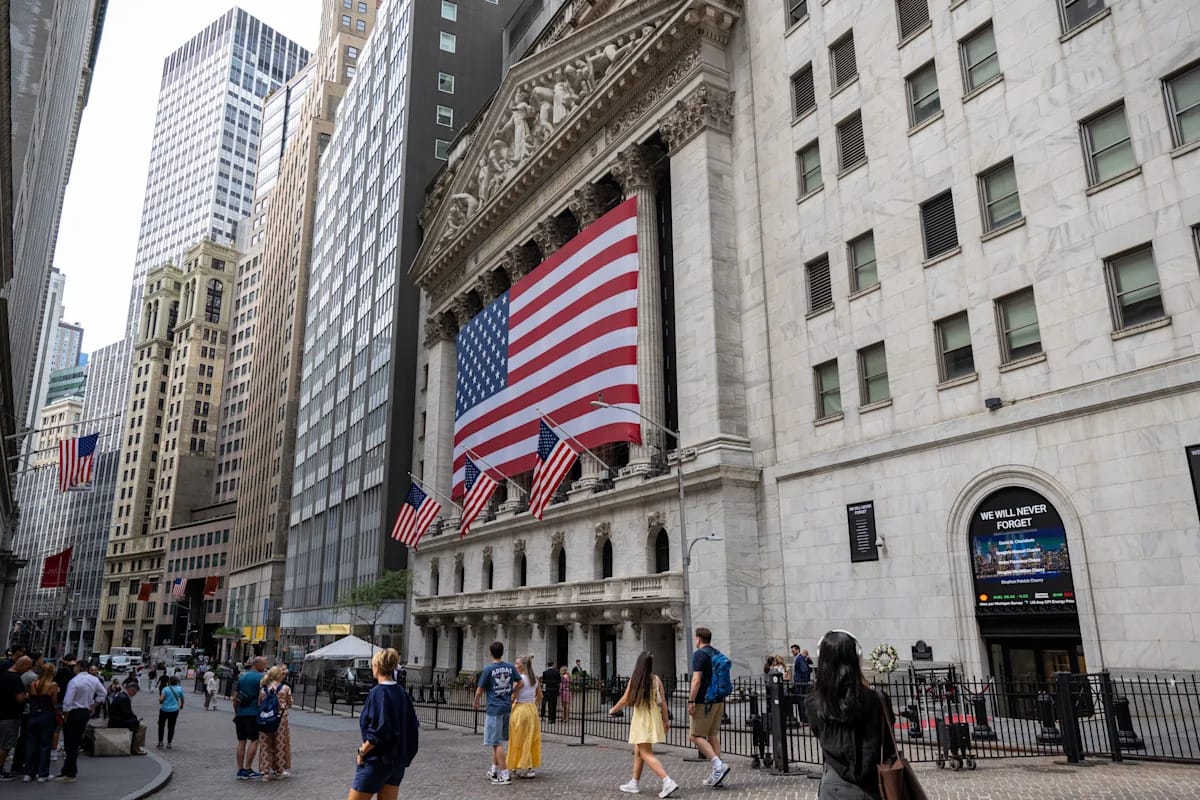
Wall Street's post-holiday reopen delivered the records the futures had been signaling. As flagged in this morning's analysis, thin early-week liquidity threatened to keep the tape choppy, but a broad memory and semiconductor surge did the heavy lifting instead: the Dow closed above 53,000 for the first time, and both the S&P 500 and Nasdaq Composite finished at fresh records. Here is how the US session actually played out.
The Close: Records Across the Board
The S&P 500 rose 0.72 percent to a record 7,537.43, clearing its prior June 30 peak of 7,499.36 on the first attempt after the July 4 break. The Nasdaq Composite added 1.12 percent to 26,121.16, and the Dow Jones Industrial Average climbed 155.84 points, or 0.29 percent, to 53,055.91, its first close above 53,000 and both a closing and intraday record. Breadth leaned with the tape: the technology sector led, with the Technology Select Sector SPDR (XLK) up almost 2 percent and the VanEck Semiconductor ETF (SMH) rising 2.3 percent.
- S&P 500 +0.72% to a record 7,537.43, clearing the June 30 peak on the first try
- Dow +155.84 points to 53,055.91, its first close ever above 53,000
- Nasdaq +1.12% to 26,121.16 as semis and memory led; SMH up 2.3%
Memory and Chips: The Story of the Day
The rally's engine was the memory and semiconductor complex, extending last week's rebound from the Meta Compute shock. Western Digital led with a jump of roughly 7 percent on tight hard-disk-drive supply, firm enterprise pricing and fresh analyst target hikes from Bank of America and Cantor Fitzgerald, with storage capacity described as effectively booked through year-end. Advanced Micro Devices climbed about 8.5 percent, Marvell Technology added roughly 4 percent, and KLA, Lam Research, Teradyne and Intel each finished more than 3 percent higher. The read-through was straightforward: investors treated last week's AI-hardware scare as a dip rather than a top.

- Western Digital jumped ~7% on tight drive supply and analyst upgrades
- AMD +8.5%, Marvell ~4%; KLA, Lam Research, Teradyne and Intel each up over 3%
- The complex extended its rebound from last week's Meta Compute shock
Cooling Services Inflation Underwrites the Bid
The macro backdrop helped. June ISM Services PMI, delayed a session by the holiday, printed 54.0, holding in expansion for a 24th straight month. The detail that mattered for rate-sensitive tech was the prices-paid index, which cooled to 67.7 from 71.3, its first reading below 70 since February and a sign that services inflation is easing. The employment sub-index also swung back to expansion at 51.2. In commodities, gold eased about 0.6 percent to near $4,161 as the dollar firmed, pulling back from a two-week high, while WTI crude slipped about 0.5 percent toward $68.40 as the geopolitical premium kept unwinding.
- ISM Services PMI at 54.0, a 24th straight month of expansion
- Prices paid cooled to 67.7, the first sub-70 reading since February
- Gold near $4,161 and WTI near $68.40, both easing on a firmer dollar
Crypto Check: A Quiet Divergence
Digital assets did not join the equity party. Bitcoin slipped about 1.4 percent to near $63,674, though it held above the $63,000 level it reclaimed over the weekend, keeping the recovery structure intact. Ethereum eased a similar 1.4 percent to around $1,793, still up double digits on the week. The modest pullback left crypto diverging from a record-setting stock tape, a reminder that this leg of the equity rally is being driven by semiconductors and cooling inflation data rather than broad risk-on flows.
- Bitcoin near $63,674 (-1.4%), still holding the weekend's $63K reclaim
- Ethereum near $1,793 (-1.4%), yet still up double digits on the week
- Crypto diverged from record stocks, a semis-and-rates driven leg rather than broad risk-on
After-Hours and Overnight Watch
The next catalyst is mechanical and immediate. SpaceX joins the Nasdaq-100 before Tuesday's open, so index-tracking funds begin buying after today's close. SpaceX itself firmed 1.08 percent to $163.75 into the event, and JPMorgan estimates roughly $4.3 billion of forced Nasdaq-100 buying, with total passive demand across all trackers running as high as $22 billion to $27 billion against a small tradable float, the setup that could amplify Tuesday's open. Beyond that, JOLTS job openings land Tuesday, and the week's swing factor, the June FOMC minutes, arrive Wednesday at 18:00 UTC, the first of the Kevin Warsh era.
These are scenarios to watch, not predictions or instructions. For the S&P 500, today's record close of 7,537.43 becomes the near-term reference zone: holding above it keeps the structure the futures flagged intact, while a slip back below the prior 7,499.36 peak would suggest the breakout needs a second attempt. The bearish trigger would be a hawkish surprise in Wednesday's minutes that firms the dollar and pressures the rate-sensitive chip names doing the leading. For Bitcoin, $63,000 remains the level structural buyers reclaimed; holding it keeps the weekend recovery intact, while a break below would soften the near-term structure.
- SpaceX joins the Nasdaq-100 before Tuesday's open; passive buying starts after today's close
- JOLTS Tuesday, then Warsh's first FOMC minutes Wednesday at 18:00 UTC is the swing factor
- S&P 7,537.43 is the new reference zone; for Bitcoin, $63K holding keeps the recovery intact
The reopen answered the morning's central question: post-holiday momentum carried the cash index through its record on the first attempt, powered by the same chip trade that wobbled a week ago. For the full schedule see our week ahead preview and our economic calendar, and follow the daily coverage on Market Insights.
ThriveInMarkets publishes market commentary for general information only and does not provide personal investment advice. Prices are live or closing levels as labeled; scheduled events and consensus figures can change, and levels cited are reference points, not instructions to buy or sell any asset.