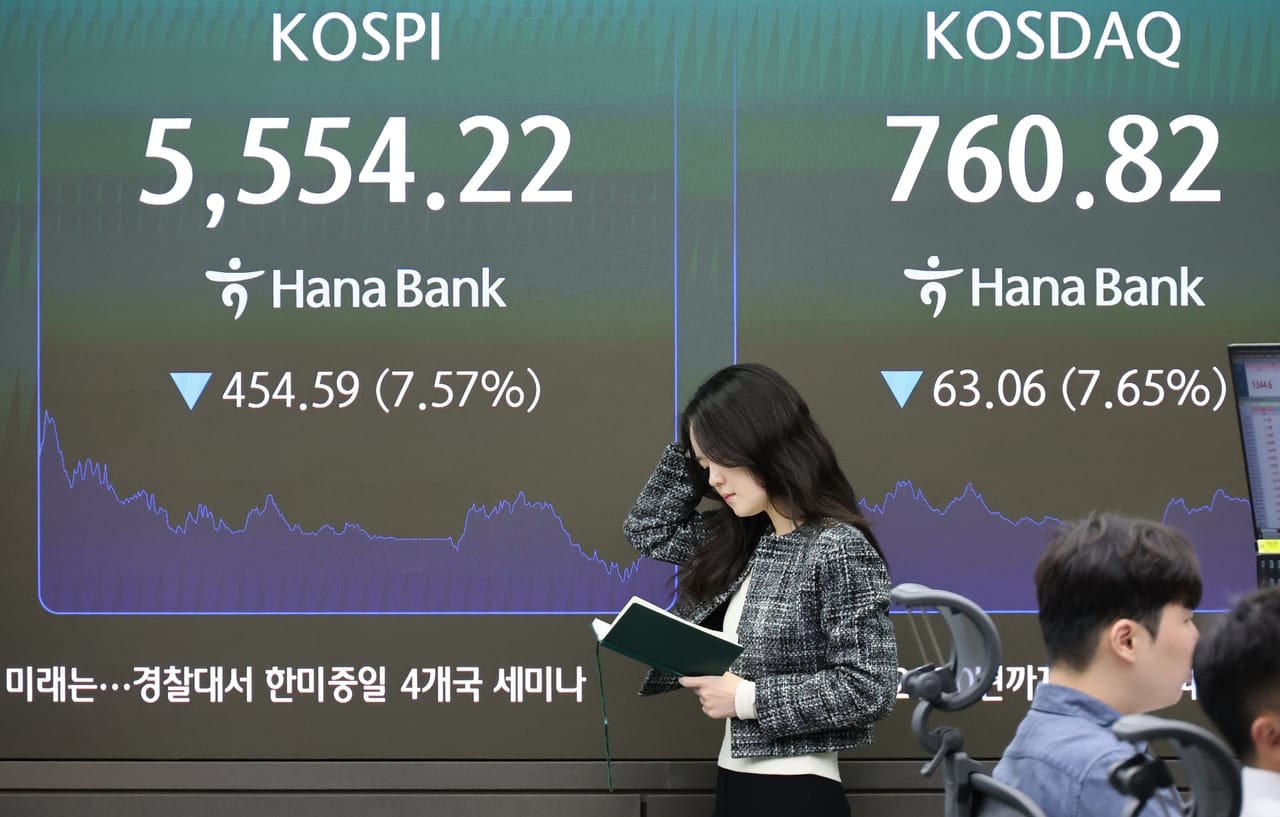
It was a bruising week for risk assets, and it ended with the market bracing for an even bigger one. A single question that has hung over this bull run all year, whether the hundreds of billions Big Tech is pouring into artificial intelligence will ever pay off, finally cracked the tape wide open. Alphabet and Tesla earnings triggered the worst day for mega-cap technology since April 2025, wiping close to $800 billion off the Magnificent Seven in one session. A midweek oil spike above $100 added an inflation scare, only to fade by Friday on hopes of US-Iran diplomacy. Wall Street closed lower across the board, gold slipped, and crypto gave back a two-week high. Below is the full scorecard for the week of July 20 to July 26, and the road map into a Federal Reserve decision and four more mega-cap reports that make next week the most consequential of the quarter.
A note on weekend pricing: traditional markets, meaning stocks, gold and oil, are closed on Sunday, so the figures below are Friday's cash-session and settlement closes (dated July 24) and reopen Monday. Bitcoin and Ether trade around the clock, so those are live prints as of 09:00 UTC on Sunday, July 26.
The Weekly Scorecard
Every major risk barometer finished the week in the red, though the damage was concentrated rather than uniform. The S&P 500 closed Friday at 7,411.98, down roughly 0.6 percent from the prior Friday's 7,457.69, a modest weekly loss that masked a violent midweek air pocket. The Nasdaq Composite ended at 24,975.82, off about 2 percent on the week, bearing the brunt of the tech selloff, while the Dow Jones Industrial Average held up best, closing near 51,947 as old-economy names offset the growth carnage. In commodities, gold settled around $4,050, down about 2.3 percent from the prior Friday's $4,146.70 as firmer real yields dulled its appeal, and WTI crude closed near $89.30, down about 3 percent on Friday alone yet still up roughly 3 percent on the week after its midweek surge. In crypto, Bitcoin trades near $64,340 and Ether near $1,879 this Sunday morning, both close to flat on the week after fading a sharp midweek rally.
- All majors lower on the week: S&P -0.6% to 7,411.98, Nasdaq -2% to 24,975.82 (Friday closes)
- Gold ~$4,050 (-2.3%) on firmer real yields; WTI ~$89.30, down Friday but up ~3% on the week
- Crypto near flat: Bitcoin ~$64,340, Ether ~$1,879 live Sunday, after fading a midweek pop
- Stocks, gold and oil reopen Monday; crypto never closed
Biggest Movers: Tech's $800 Billion Session
The defining event was Thursday's rout. After Alphabet and Tesla, the first two Magnificent Seven names to report this quarter, delivered results Wednesday evening, the seven largest US technology stocks shed roughly $797 billion in market value in a single Thursday session, their worst day since April 2025. The trigger was not the headline numbers but the spending behind them. Tesla fell about 14 percent after a second-quarter miss in which capital expenditure soared 142 percent to $5.79 billion, and Alphabet dropped about 7 percent even on a solid quarter because it lifted full-year capex guidance to a $195 billion to $205 billion range. The message landed hard: if the most disciplined spenders are guiding higher, the payback horizon for the entire AI trade just stretched further out, and the richest valuations wear that risk first.
The pain radiated through semiconductors and memory, with Intel sliding 7.89 percent and SanDisk tumbling about 11 percent on Friday. Not everything bled, though. 3M jumped more than 7 percent and General Motors rose nearly 5 percent on clean beats, the kind of industrial strength that cushioned the Dow. The CBOE Volatility Index climbed to 18.70 as nerves frayed, a reminder that a quiet-looking weekly loss can hide a lot of intraday violence.

- The Magnificent Seven shed ~$797B Thursday, the worst mega-cap tech day since April 2025
- Tesla -14% on a Q2 miss (capex +142% to $5.79B); Alphabet -7% after lifting 2026 capex to $195-205B
- Intel -7.89%, SanDisk -11% led chip weakness; 3M +7%, GM +5% cushioned the Dow
- The VIX rose to 18.70 as volatility returned
Oil, Gold and the Macro Turn
The macro story swung twice in one week. Midweek, Brent crude vaulted above $100 for the first time since May, driven by Houthi attacks on Red Sea tankers, President Trump's threat of a strike on Iran, and damage to the Caspian Pipeline Consortium terminal that handles most Kazakh crude. That surge briefly revived the prospect of a Federal Reserve rate hike, with money markets pricing as much as a 35 percent chance of an increase at the July 28-29 meeting. Then the pendulum swung back. On Friday, oil retreated sharply, with Brent falling roughly 4 percent toward $96 and WTI settling near $89.30, after reports that Pakistan, backed by China, was seeking to revive negotiations between the US and Iran. The de-escalation hope cooled the inflation scare and pulled some of the hawkish repricing back out of the curve.
Gold spent the week on the back foot, easing to around $4,050 as higher real yields did the damage, though it held comfortably above the $4,000 handle. Across the Atlantic, the European Central Bank held its key rates unchanged, with President Christine Lagarde cautioning that inflation is expected to stay above target into at least the first half of 2027. The net effect of the week was a market that talked itself into a hawkish panic on Wednesday and most of the way back out of it by Friday, which is precisely why next week's Fed meeting now carries so much weight.
- Brent topped $100 midweek on Iran and Red Sea risk, then fell ~4% Friday on US-Iran diplomacy hopes
- Fed hike odds spiked to ~35% on the oil scare, then cooled as crude retreated
- Gold ~$4,050 (-2.3%) on firmer real yields, still above $4,000
- The ECB held rates; Lagarde flagged above-target inflation into 2027
Crypto: A Two-Week High, Then a Cooldown
Digital assets were the composed corner of the market for most of the week before easing back with risk. Bitcoin pushed to a two-week high above $66,000 midweek, buoyed by progress on the CLARITY Act, the market-structure bill that would split US oversight of digital assets between the SEC and the CFTC, and by positive spot exchange-traded-fund flows. By this Sunday it has cooled to about $64,340, roughly flat on the week, while Ether sits near $1,879. The pullback was orderly rather than a crypto-specific unwind, a notable contrast to the hundreds of billions equities shed in a single day.
The policy and infrastructure headlines did the heavy lifting. Senate Republicans advanced an updated CLARITY Act draft, though the window to pass it before the August recess is narrowing as Democratic opposition hardens. On the commercial side, Visa launched a stablecoin platform that lets banks, fintechs and payment providers issue, hold and transfer stablecoins, a meaningful step toward mainstream settlement rails, while the US government moved $288 million of seized Bitcoin and Ether to Coinbase Prime, stirring speculation about a potential sale. Live levels and ETF-flow data for the top of the market are visible on the ThriveInMarkets homepage.
- Bitcoin touched a two-week high above $66K midweek on CLARITY Act progress, then cooled to ~$64,340
- Ether near $1,879; the pullback was orderly, not a crypto-specific unwind
- Visa launched a stablecoin platform; the US moved $288M of seized crypto to Coinbase Prime
- The CLARITY Act advanced but faces a shrinking pre-recess window
Week Ahead: A Live Fed and Four More Magnificent Seven Reports
The coming week is arguably the most consequential of the quarter. These are the catalysts and levels to watch for direction, not instructions to act on any asset:
- The FOMC decision on Wednesday, July 29. Policymakers are widely expected to hold, but this two-day meeting turned genuinely live after the oil scare, and traders watching for the tone of Chair Kevin Warsh's press conference will parse every word for whether the June hawkish language softens. There is no updated dot plot, so the statement and the presser carry the full signal.
- Four more Magnificent Seven reports. Microsoft and Meta report Wednesday, July 29, with Apple and Amazon on Thursday, July 30, plus Qualcomm, Visa, Mastercard, Exxon Mobil and Chevron. After this week's capex-driven selloff, the market will scrutinise cloud and AI spending guidance far more than the headline beats.
- A heavy macro slate. Thursday brings the advance reading of second-quarter GDP alongside PCE inflation, personal income and spending, and Friday adds the Chicago PMI and University of Michigan consumer sentiment. Any hot inflation print would collide with the AI-capex debate.
- Oil and the Iran premium. Friday's retreat hinges on fragile diplomacy. A breakdown in US-Iran talks or fresh Red Sea escalation could send crude back toward $100 and revive the inflation and rate worries the market just talked itself out of.
- Bitcoin's $64K to $66K zone. The band Bitcoin has traded this week remains the crypto reference into a CLARITY Act timeline that risks slipping into the August recess.
- FOMC July 28-29 is live; watch Chair Warsh's tone and the statement, with no dot plot to lean on
- Microsoft, Meta, Apple, Amazon report; AI capex guidance is the swing factor after this week's rout
- Q2 GDP, PCE inflation (Thu) and Chicago PMI, Michigan sentiment (Fri) headline the data
- Oil's Iran premium and Bitcoin's $64-66K zone stay the reference points
For the daily play-by-play behind this recap, browse this week's coverage on Market Insights, revisit the weekly news roundup, and check the economic calendar for next week's catalysts.
ThriveInMarkets publishes market commentary for general information only and does not provide personal investment advice. Weekly figures are drawn from Friday cash-session and settlement closes for stocks, gold and oil, which are closed on weekends, and from live crypto prints; levels cited are reference points, not instructions to buy or sell any asset.