You can be right about where price is going and still lose money. It sounds unfair, but it happens all the time, and it's one of the most useful things to understand early.
1. Direction is only half the picture
"Bitcoin is going up" is a direction. Everyone has an opinion like that. On its own, it doesn't tell you where to get in, where you're wrong, or how much room price needs before it moves.
Price almost never travels in a straight line. It dips, stalls, shakes people out, and then moves. That route is the path, and the path is what decides whether a trade works.
2. Right call, stopped out anyway
Here's a real example, just as an illustration. On the BTC daily chart, price set a low around 76.0k on 11 Sep 2026 and held near there again on 14 Sep (about 76.35k). A stop placed just under that obvious low would have felt safe.
On 15 Sep a wick dipped to around 74.9k, straight through that stop, and then price turned higher. On 21 Sep it hit around 87.4k.
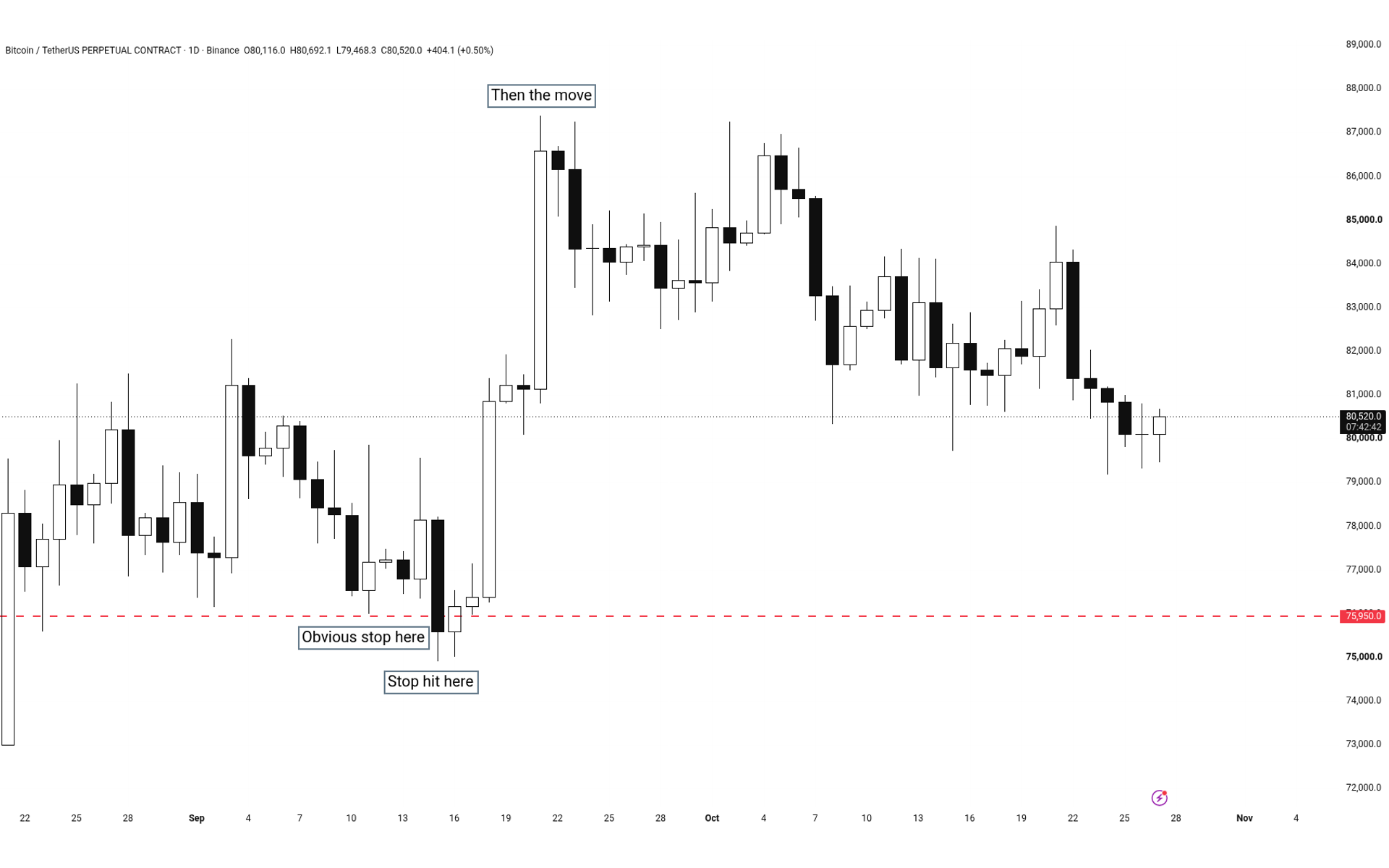
Anyone who said "up" was right. Anyone whose stop sat right under the obvious low was out before the move. Same direction, very different result.
3. Read the path instead
Now look at the same stretch, but this time focus on how price got there:
- Pullback: after the 15 Sep shakeout to about 74.9k, price retests that area on 16 Sep (low about 75.0k) and holds.
- Pause: it pushes up, then goes quiet for a couple of candles around 81k (19-20 Sep).
- Break: a strong candle on 21 Sep leaves the pause behind. That's a clear point where the move confirms itself.
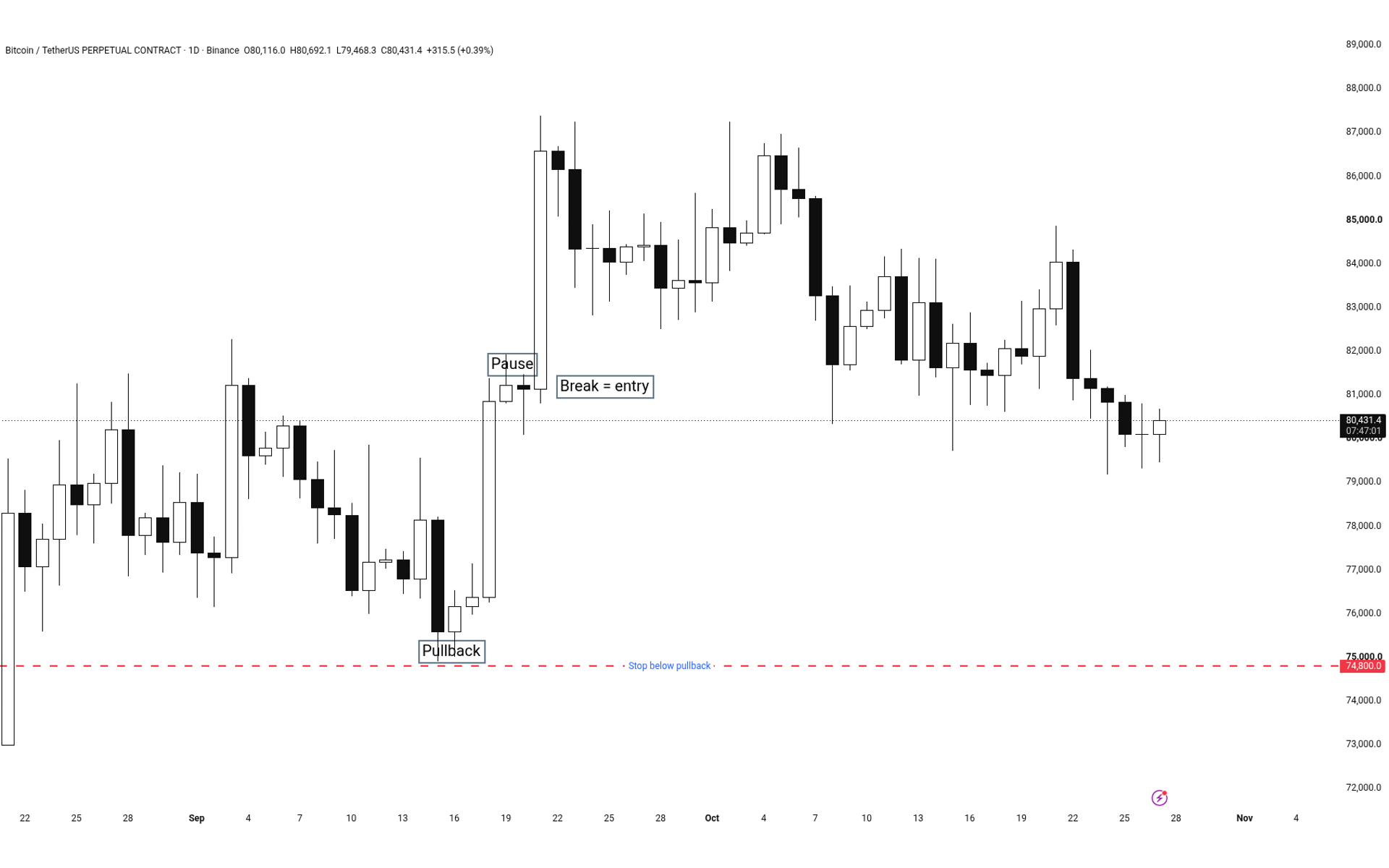
Each of those steps gives you something to work with. The break gives you an entry idea. The pullback gives you a level to put your stop under: below the shakeout low around 74.9k, where the idea is actually wrong. That's a different spot from the obvious 76k low, which is where everyone else's stop sat and got hit.
4. Why the obvious low is a trap
When a low is easy to see, lots of stops end up just below it. Price often (not always) dips through that spot before deciding where to go. If your stop is in the same place as everyone else's, you're more likely to get caught in that dip. Giving the trade room, or waiting for the path to confirm, can help.
5. This helps investors too
Even if you just buy and hold, reading the path helps. Buying into a pullback or after a clean break usually feels a lot better than buying the top of a spike and sitting through the drop.
6. Questions to ask the chart
- Where did price last pull back, and did it hold?
- Is it pausing right now, or already moving?
- What would a clear break look like from here?
- If I'm wrong, where does the chart prove it?
These build on what we covered in Reading Your First Chart and in Day 5, Why Price Action Comes First.
You can practise marking pullbacks, pauses and breaks on any chart for free on TradingView (affiliate link). Try it on a past move before you look at what happens next.
Today's takeaway
- Being right about direction isn't enough.
- The path is where entries and stops live.
- Read the pullback, the pause and the break.
- Put your stop where the idea is wrong, not just under the obvious low.
- Stop asking where it's going. Ask how it gets there.
Educational only, not financial advice. Trading involves risk of loss. No profits are promised. Chart levels are approximate, from BTCUSDT perpetual daily candles (UTC). The TradingView link is an affiliate link.
← Previous lesson: Why Price Action Comes First · Next lesson: see the full series →