The Nasdaq fell this week after Intel cut its chip outlook, and Friday's close was the index's worst session since June. The week in markets ran from October 25 to October 31, 2026. Monday's morning analysis opened with oil easing from a six-month high; by Friday, the evening review had chips leading a two-day unwind. The Associated Press put the Nasdaq at 25,437.00, down 2 percent on the week and 2.9 percent on Friday. The S&P 500 closed 7,580.07, down 0.6 percent on the week. The Dow finished 51,770.31, down 0.9 percent. Intel's guide, Alphabet's cash miss, Amazon's sales miss, a Federal Reserve hold, and a 6.3 billion dollar Binance theft sat on the same calendar. This note covers why those stories matter.
Top Stock Stories of the Week
Intel's guide triggers the worst session since 1974
Intel reported third-quarter revenue of 16.51 billion dollars, up 21 percent, and adjusted earnings of 52 cents a share against about 40 cents expected (Reuters). Data Center and AI revenue jumped 78 percent to 7.3 billion dollars. The PC-heavy client group fell 5 percent to 8.1 billion dollars. Fourth-quarter sales were guided to 15 to 16 billion dollars against about 17 billion. A factory explosion in Israel will cost about 600 million dollars of revenue over two quarters. Shares dropped about 29 percent on Friday, the worst session since 1974, and Nvidia and AMD followed. Why it matters: the AI bid had treated Intel as a turnaround in the same tape as the hyperscalers. Friday's morning analysis had the after-hours drop at 16 to 23 percent; cash extended it.
Alphabet misses as Google Cloud doubles
Alphabet reported third-quarter revenue of 127.6 billion dollars against about 128.2 billion, and adjusted earnings of 2.67 dollars a share against 3.02 (Reuters). Google Cloud more than doubled to 30.71 billion dollars. Search advertising rose 12 percent to 63.4 billion dollars, slowing from 17 percent in the second quarter. Free cash flow printed a 9.07 billion dollar outflow on 51.4 billion of capital spending. Class A shares fell about 13 percent on Thursday, as Thursday's evening review laid out. Why it matters: Cloud is now a backlog story, and Search is no longer growing fast enough to hide the cash cost.
Amazon misses on sales as Microsoft keeps generating cash
Amazon posted third-quarter sales of 201.9 billion dollars against about 202.3 billion, and earnings of 1.89 dollars a share against about 1.96 (CNBC). Amazon Web Services rose 39.3 percent to 46.0 billion dollars, the fastest growth in nearly five years. Trailing twelve-month free cash flow was a 42.4 billion dollar outflow after 77.3 billion of capital spending in the quarter. Management held 2026 cash capital expenditures at about 220 billion dollars. Microsoft was the cash exception. Revenue rose 19 percent to 92.28 billion dollars, Azure grew 48 percent to 33.17 billion, and free cash flow printed 18.6 billion dollars (Reuters). Why it matters: three hyperscalers printed in two sessions, and only Microsoft still converted the AI build into spare cash. That is the template into Apple on Monday.
Eli Lilly raises the year; Anthropic files to list
Eli Lilly reported third-quarter revenue of 24.4 billion dollars, up 39 percent, and lifted 2026 revenue guidance to 91 to 92 billion dollars. Mounjaro sales were 10.72 billion dollars, up 65 percent. Shares added about 3 percent on Friday, the largest positive S&P 500 contributor on a day Nvidia subtracted the most points. Anthropic made its S-1 public on Monday for a Nasdaq listing under ticker ANT, with first-half revenue of 16.3 billion dollars (The Verge, Reuters). Why it matters: the week's winners sat outside the chip complex.
- Nasdaq closed 25,437.00, down 2 percent on the week; Friday -2.9 percent was the worst session since June
- Intel about -29 percent after Q4 sales guided 15 to 16 billion dollars; Alphabet free cash flow -9.07 billion
- Amazon AWS +39.3 percent with free cash flow -42.4 billion; Microsoft Azure +48 percent and free cash flow 18.6 billion
Top Crypto Stories of the Week
Binance records the largest crypto theft on record
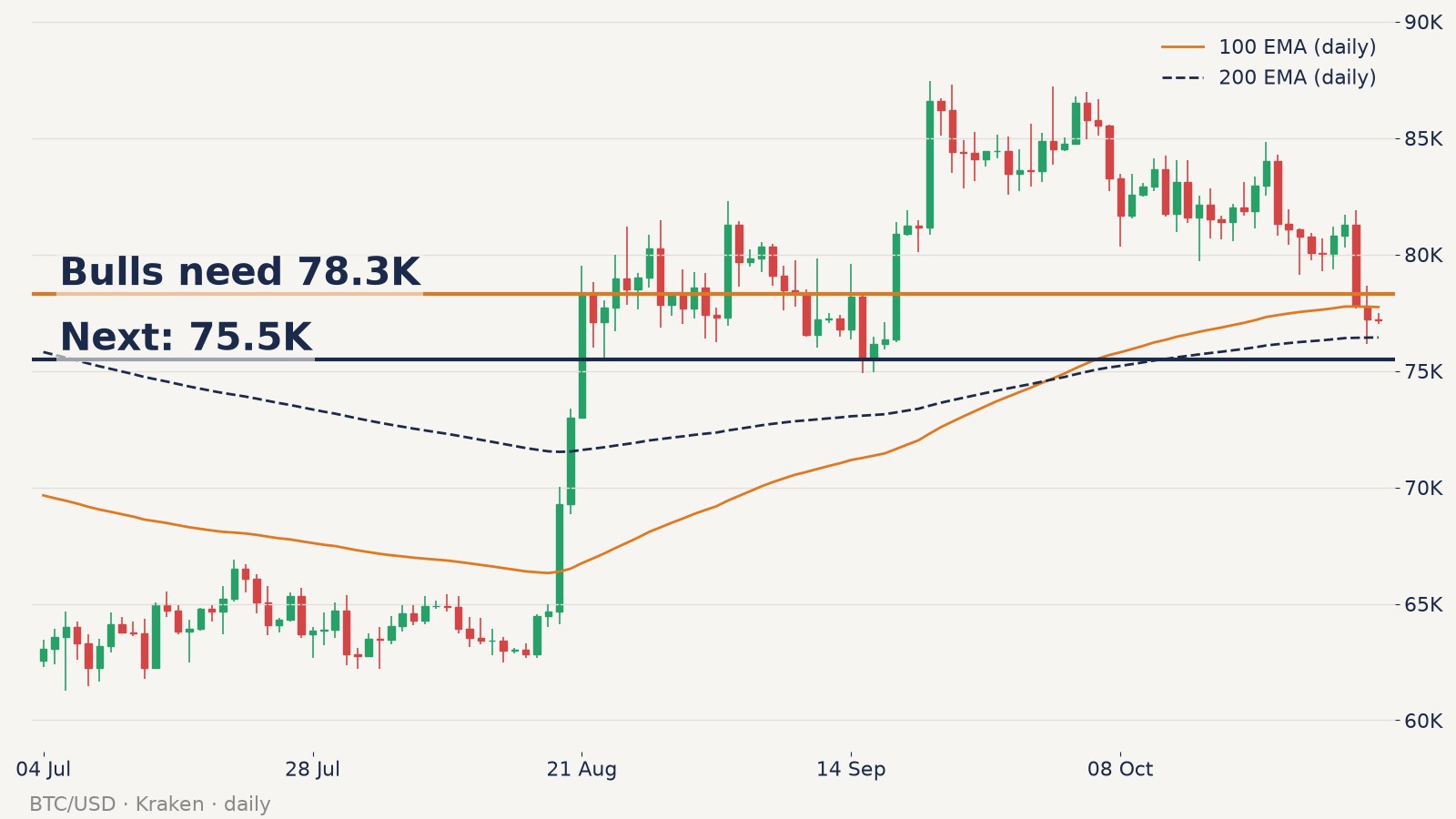
On Thursday around 20:05 UTC, attackers moved about 6.3 billion dollars out of Binance hot wallets across ten blockchains, most of it in about 20 minutes (TRM Labs, Binance). The haul included about 18,270 Bitcoin, about 3.8 billion dollars on Ethereum, 628 million on Tron, about 296 million in XRP, and about 96 million on Solana. TRM Labs said with high confidence that TraderTraitor, a North Korean unit linked to the Lazarus Group, carried out the attack. Tether, Circle, and other partners froze about 3 billion dollars. Binance paused withdrawals, said it has set aside more than 6.34 billion dollars of company resources, and aims to restart on Sunday. Bitcoin last printed about 77,300 dollars on Saturday, down from about 80,600 a week earlier. A separate weekend note walks the chart levels. Why it matters: this is four times the 2025 Bybit hack in dollar terms. The weekend still turns on whether Sunday's reopen is smooth.
Solana and Ether funds leak; XRP stays the relative bid
US spot Bitcoin ETFs posted 643 million dollars of net outflows on Friday, leaving the seven-day total about 202 million negative (SoSoValue). Ether funds lost about 431 million dollars on the week. Solana products recorded a fifth straight outflow session, with about 72 million dollars leaving on the week. XRP funds remain the 30-day exception, with about 19 million dollars of net inflows. Solana last printed about 96 dollars. XRP last printed about 1.25 dollars. Tron was among the largest large-cap losers, down about 10 percent into Saturday, after USDT left Binance's Tron wallet in the first minutes of the attack. Why it matters: the ETF bid is no longer one-way, and it is not treating every large-cap token the same.
Coinbase returns to profit as trading stays weak
Coinbase reported third-quarter net income of 719 million dollars, or 2.51 dollars a share, after three losing quarters (Reuters, CNBC). Transaction revenue fell 43 percent to 590 million dollars. A 715 million dollar unrealized gain on crypto investments did most of the GAAP work. Why it matters: the listed US exchange printed a profit on the same day Binance was drained. The quality of that profit is the investment book, not the trading engine.
- Binance impact about 6.3 billion dollars; about 3 billion frozen; withdrawals aimed at Sunday
- Bitcoin last near 77,300 dollars; Friday Bitcoin ETF outflows 643 million dollars
- Solana ETFs posted a fifth outflow session; XRP funds remain the 30-day inflow exception
M&A, Partnerships, Deals
Intesa Sanpaolo moved on Banca Monte dei Paschi di Siena in a deal valued at about 35 billion euros, while MPS's own offer for Banco BPM lapsed. Tesco agreed to sell its Czech and Slovak businesses to Ahold Delhaize for about 1.7 billion euros. Vistra completed a 4 billion dollar purchase of the Cogentrix gas fleet. Tether and Circle's freezes recovered about half of a record theft in hours. Why it matters: the cash deals sat in European banks, grocery, and US power, not in mega-cap tech.
- Intesa Sanpaolo's Monte dei Paschi deal about 35 billion euros
- Tesco to sell Czech and Slovak arms to Ahold Delhaize for about 1.7 billion euros
- Vistra closed a 4 billion dollar Cogentrix purchase; Tether and Circle froze about 3 billion dollars
Regulatory & Macro
The Federal Open Market Committee voted 10-2 on Wednesday to hold the funds rate at 3.75 to 4.00 percent, as Wednesday's evening review had as the base case. Governor Lisa Cook and Cleveland President Beth Hammack dissented for a quarter-point hike. Chair Kevin Warsh said inflation "remains elevated" and wants more information before December. Futures still assigned about an 85 percent chance of a December hike (CME FedWatch via Axios). Real GDP rose at a 3.4 percent annual rate in the third quarter (BEA). September PCE inflation rose 3.6 percent from a year earlier; core PCE was 3.1 percent. The Employment Cost Index rose 0.8 percent in the third quarter (BLS).
The Bank of Canada raised its overnight rate by a quarter point to 2.5 percent, the first increase since July 2023. The Bank of Japan held at 1.25 percent and said underlying inflation is consistent with the 2 percent target for the first time since 2013 (Bank of Japan, CNBC). The ECB held the deposit rate at 2.50 percent and flagged December; President Christine Lagarde said she will step down on February 7. Chancellor John Healey doubled the UK bank-profit surcharge to 6 percent for 15 months. Gold closed Friday at 3,875.65 dollars, a one-year low (GoldPrice.com). West Texas Intermediate last settled about 104.10 dollars, still elevated after last week's Houthi strikes. Why it matters: central banks held or hiked into the same oil shock, and gold sold off as December hike odds stayed high.
- Fed held at 3.75 to 4.00 percent, 10-2, with Cook and Hammack dissenting for a hike
- Q3 GDP 3.4 percent; September PCE 3.6 percent year over year; BoC hiked to 2.5 percent
- Gold closed 3,875.65 dollars, a one-year low; WTI about 104.10 dollars
Week Ahead: What to Watch
- Sunday, November 1: Binance aims to restart withdrawals. A delay would feed back into Bitcoin's 75,500 to 78,300 dollar zone, as the weekend Bitcoin note sets out.
- Monday, November 2: Apple reports after the US close, the last Magnificent 7 print before Nvidia on November 17.
- Tuesday, November 3: US midterm elections. The next FOMC is in December.
- Thursday, November 5: Bank of England decision, against the same oil-and-inflation mix that pulled the Bank of Canada into a hike.
The docket is on the ThriveInMarkets calendar. The question the week leaves hanging is whether Friday's chip session becomes the template into Apple, or whether Microsoft's cash print is the one that holds once Binance reopens.
- Sunday: Binance withdrawal restart
- Monday after the close: Apple
- Tuesday: US midterms; Thursday: Bank of England