Price goes where the orders are waiting.
In Day 22 we built a checklist to tell a real breakout from a fake-out. In Day 24 we drew levels from closes and treated a wick past the level as a probe, not a break. Today is the why: why does price poke just past a level so often, and then come back?
The short answer is orders. Orders gather just past every obvious level, and price tends to travel to them.
1. What sits just past a level
Under a support level, two groups leave orders. Traders who bought near the level put their stop-losses a little below it, so they get out if it breaks. Traders who want to sell the breakdown put sell orders in the same place, ready to trigger. Both are sell orders, sitting at the same obvious price.
Above a resistance level it runs the other way. Short sellers put their stop-losses a little above the high, and breakout buyers put buy orders there. Both are buy orders.
The more obvious the level, the bigger the pile. Round numbers, prior swing highs and lows, and the edges of a range are where everyone looks, so that is where the orders gather.
2. Why price goes there
A large buyer cannot buy a big size in a quiet market without pushing the price up against themselves. They need sellers. A pile of sell stops under support is exactly that: a batch of sell orders that all fire at once when price touches them.
So price dips through the level, the stops trigger, the selling gets absorbed, and then there is nobody left to sell at that price. Price comes back above the level. On the chart it is a wick. To the traders who got stopped out, it is a fake-out.
This is a tendency, not a rule. Not every wick is a planned sweep, and not every level holds after one. But it explains why the zone just past an obvious level is where so many turns start.
3. A real example: Bitcoin at 100,000 in 2025
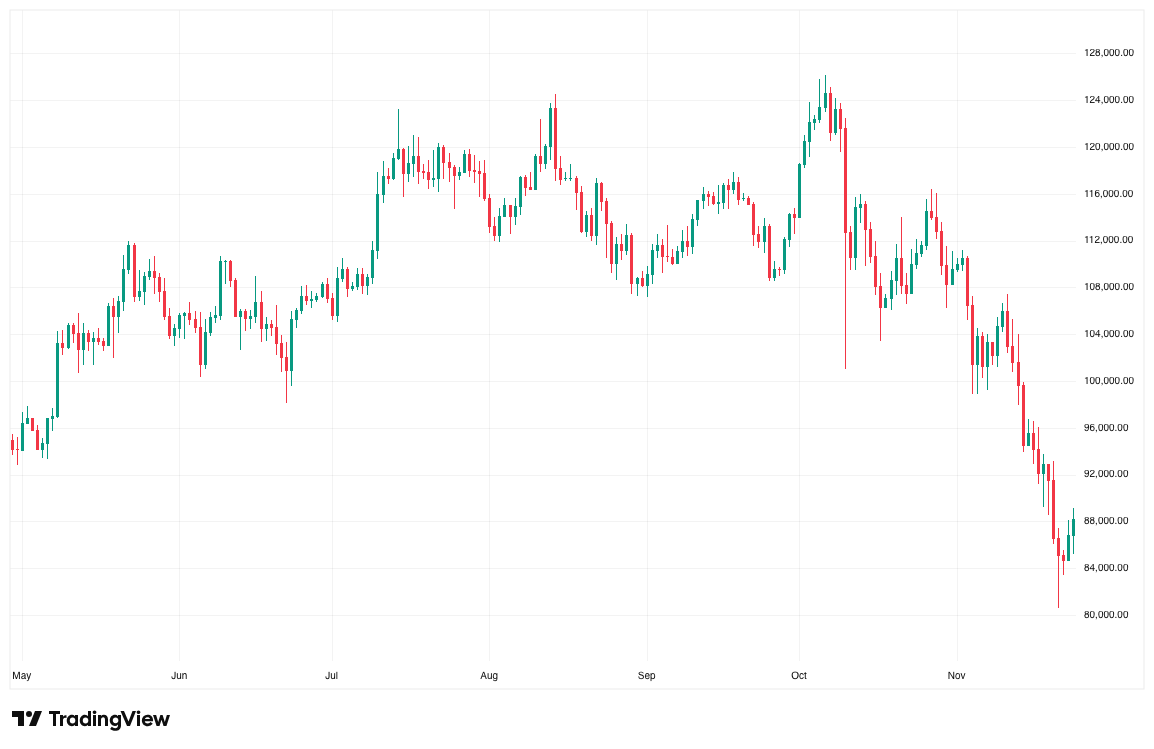
BTCUSDT perpetual, daily, Bybit, May to November 2025.
100,000 was the most watched number in the market. On 8 May 2025 Bitcoin closed back above it, at 103,240.0. From then on, every long who bought near 100,000 had a reason to keep a stop just under it.
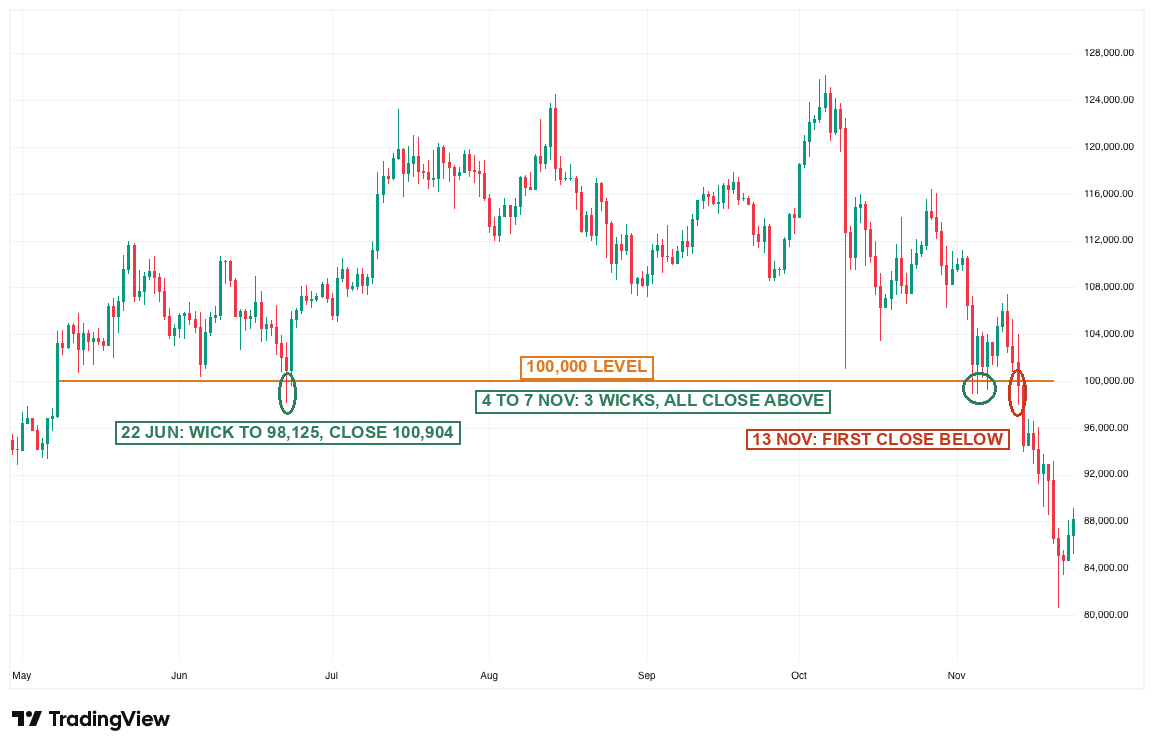
BTCUSDT perpetual, daily, Bybit. Green rings: wicks under 100,000 that closed back above. Red ring: the first daily close below.
The sweeps that held
On 22 June the daily low reached 98,125.0, under the level, and the day closed at 100,904.3, back above it. The next day wicked to 99,581.0 and closed at 105,283.5. The week that started on 23 June closed at 108,314.8.
In early November it happened again. The daily lows were 98,888.1 on 4 November, 98,894.6 on 5 November and 99,201.8 on 7 November. Each of those days closed back above 100,000.
Count them: from May to mid-November there were five daily wicks under 100,000, and every one of them closed back above it. Each time, the stops under the level were taken, and price came back.
The close that did not come back
On 13 November the low reached 97,931.0 and the day closed at 99,629.0. That was the first daily close below 100,000 since May. The next day closed at 94,533.3.
A level that keeps getting swept is being tested again and again. Each test tends to use up some of the buyers who defend it. When the close finally stays below, the sweep has stopped working, and the level has broken. The wick was a probe. The close was the answer.
4. What this means for your stops
If price tends to travel to where the stops sit, then a stop placed exactly at the obvious spot is sitting in the most probed place on the chart. That does not mean it will be hit every time. It means you should place it knowingly.
Two ideas to test on your own charts. First, put your stop past the zone where wicks usually reach, not right at the level, and size the position smaller so the wider stop risks the same amount. Second, let the close decide, as in Day 24: a close back inside points to a sweep, a close through points to a break.
And plan for both, the way we did in Day 1: Plan 3 Paths Before Every Trade. A sweep can hold, or it can be the first sign of a real break. The close tells you which one you are watching.
Price goes where the orders are waiting. Know where they sit, and let the close tell you what happened there.
← Previous: Day 25: Four Quick Reversals Every Trader Should Know · Next: Day 27 (coming soon) · Browse all daily lessons
Educational only, not financial advice. Trading involves risk of loss. No profits are promised.